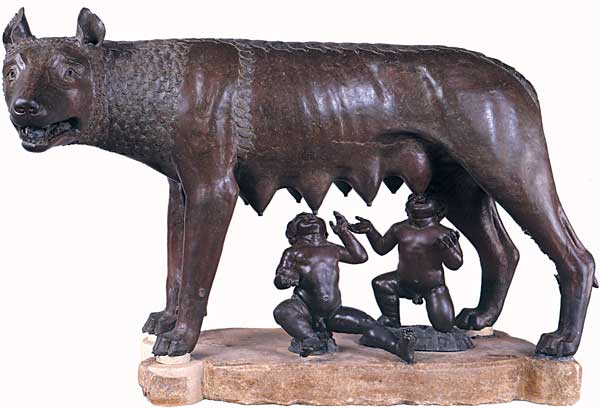
La Loba Capitolina o Luperca es una escultura esculpida en bronce que se encuentra en los Museos Capitolinos (Roma, Italia), aunque existen copias por todo el mundo, como la que se encuentra fuera del museo y es fotografiada por millones de turistas. El conjunto escultórico lo forman tres figuras: una loba y dos pequeñas figuras antropomorfas que son amamantados. Esta recreación responde al mito fundacional de Roma datado en el 753 a.C, en donde la loba sería Luperca y los niños Rómulo y Remo, fundadores mitológicos de la ciudad. Sin embargo, cuando hablamos de esta leyenda tenemos que tener en cuenta que existen dos versiones:
La primera, tal y como la recoge Tito Livio, narra cómo en el siglo VII el rey Numitor está gobernando en Alba Longa (ciudad fundada por Ascanio hijo de Eneas), hasta que su hermano Amulio decide derrocarlo y proclamarse rey, pero para asegurarse el reinado éste encarcelarla a Numitor y encierra a Rea Silva (hija de Numitor) convirtiéndola en vestal y con «quien tuvo dos hijos, Numitor y Amulio. A Numitor, el amyor, le legó el antiguo trono de la casa Silvia. La violencia, sin embargo, resultó más fuerte que la voluntad paterna o que el respeto debido a la antiguedad de su hermano, pues Amulio le expulsó y se apoderó de la corona» (Tito Livio, trad. en 2018:página 10).
Un día Real Silva sueña que es forzada por el Dios Martes y queda embarazada de los gemelos Rómulo y Remo, pero cuando su tío Amulio se entera rompe en cólera, ya que al ser una vestal no puede quedarse embarazada y menos de un Dios, por lo que como consecuencia la intenta matar, ya que había roto su voto de castidad, y esto era lo que le ocurría a las vestales que rompían el voto de castidad.
Finalmente, la hija de Numitor es asesinada y Amulio intenta acabar con los gemelos. Para ello ordena a uno de los trabajadores deshacerse de ellos. Sin embargo, es tanta la compasión que tiene por ellos que los deja en un cesto en el río Tiber.
Ell cesto con los niños no se desplazó demasiado,permitiendo que los gemelos no se ahogasen. El cesto dio a parar al lado de una cueva conocida como Luperca que se encontraba entre las colinas del Capitolio y del Palatino en la cual habitaban, entre otros animales, un pájaro carpintero y una loba que acababa de tener crías (estos dos animales eran los animales sagrados de Marte).
La loba se acercó a los gemelos y por instinto cuidó de ellos, hasta que un día un pastor que andaba por allí llamado Fáustulo escuchó el sollozo de los niños y decidió recogerlos y llevarlos a su casa junto con su mujer Aca Larentia para criarlos.
Cuando los gemelos crecieron, sus padres les revelaron su verdadera identidad y estos decidieron vengarse y honrar a su abuelo Numitor poniendo rumbo hacia la ciudad de Alba Longa.
Una vez que Rómulo y Remo llegan a la ciudad matan a su tío Amulio, quien años antes había asesinado a su madre Rea Silva, los había intentado matar a ellos y tenía encarcelado a su abuelo.
Cuando Amulio es finalmente asesinado, su abuelo es repuesto en el trono, y los gemelos abandonan Alba Longa, marchando al lugar en donde el pastor Fáustulo los encontró, decidiendo fundar su propia ciudad. Surge aquí una disputa entre los hermanos ya que Remo quería construir la ciudad en el Aventino y Romulo en el Palatino.
Tras un largo enfrentamiento Remo resulta herido y fallece al poco tiempo, por lo que Roma finalmente es fundada en el Palatino. La ciudad toma como símbolo la escultura de la Loba Capitolina en honor a Romulo y Remo.
La segunda leyenda, también recogida por Tito Livio, narra que no sería una loba quien cuidaría de los niños, sino que Luperca habría sido una mujer. Esta teoría se basa en que una «lupa» en latín significaba «prostituta», etimología que también es compartida por el término «lupanar», es decir, de los prostíbulos romanos, y es que según esta segunda narración una prostituta habría encontrado a los niños en una cesta a las orillas del Tíber y los habría cuidado como si fueran suyos con ayuda de Fáustulo, su esposo, que se dedicaba al pastoreo lejos de la capital.
La figura de la Loba Capitolina y los gemelos Rómulo y Remo han generado una gran polémica en cuanto a la datación de la famosa escultura generando principalmente dos teorías. La primera teoría defiende que pertenece al arte etrusco mientras que la segunda plantea una cronología medieval.
Esta teoría es propuesta por el arqueólogo Johann Joachim Winckelmann en el siglo XVIII. Su planteamiento dataría a la escultura como obra del siglo V a.C., correspondiendo al arte etrusco. Fuentes como Cicerón, Plinio el Viejo y Tito Livio ya habían expuesto en sus tratados la existencia de una escultura en el foro romano, que representaría la fundación de Roma a través de una leyenda mitológica, pudiéndose referir a esta.
Figura 1. La Loba Capitolina o luperca amamantando a Rómulo y Remo. Museos Capitolinos. Fuente
Segunda teoría, perteneciente a la Edad Media.
Sin embargo, la anterior teoría se ve anulada cuando a finales del siglo XIX la escultura es restaurada e investigadores alemanes descubren que la manera de efectuar el proceso de fundición no corresponde con época etrusca y sí con la Edad Media, específicamente con los siglos XII y XIII. Tras ello se realizó la prueba del carbono 14 para conseguir una mayor exactitud en la datación de la escultura y finalmente en 2007/2008 se anunció oficialmente la nueva datación que establecería la fecha de la obra entre el 1020 y el 1152 d.C. («dating the statue to 1020–1152 CE with a confidence level of 95.4%») (L. Calcagnile et al., 2019: 211).Hay que destacar también que el conjunto escultórico no fue elaborado en su totalidad en un primer momento, sino que las figuras de los niños fueron añadidos con posterioridad, en el siglo XV. Esto lleva a pensar que la escultura original no representaría a la Loba Capitolina en un primer momento sino que tendría como fin la exaltación de un animal apotropaico. En un segundo plano queda la incógnita todavía de si la obra es original medieval o es una copia de una escultura anterior.
Figura 2. Prueba de Carbono 14 confirma la datación de la obra entre 1020 y 1152 d.C con un 95.4% de fiabilidad. Fuente
Conclusión
Tras lo expuesto, podemos concluir que la obra escultórica conocida como La Loba Capitolina o Luperca no pertenece a época etrusca sino a época medieval, por mas que siga abierto el debate sobre si corresponde a una copia escultórica de época anterior.
Bibliografía
Augias, C. (2007). Los Secretos de Roma: Historia, lugares y personajes de una capital. Debate.
Calcagnile, L., D’Elia, M., Maruccio, L., Braione, E., Celant, A., & Quarta, G. (2019). Solving an historical puzzle: Radiocarbon dating the Capitoline she wolf. Nuclear Instruments and Methods in Physics Research Section B: Beam Interactions with Materials and Atoms, 455, 209-212. https://doi.org/10.1016/j.nimb.2019.01.008
Carruba, M.A (2006) La Lupa Capitolina. Un bronze medievale (presentazione di Adriano La Regina). De Luca Editori d´Arte.
Livio, T (2018). La Fundación de Roma: Rómulo y Remo. Edhasa.
This translation was generated automatically using qwen2.5:14b-instruct and has not been reviewed by a human editor. It may contain errors, omissions or awkward phrasing — for the authoritative version, please read the original in Spanish. Found a mistake? Let us know at info@arqueotimes.es.
The Capitoline Wolf or Luperca is a bronze sculpture located in the Capitoline Museums (Rome, Italy), although there are copies all over the world, such as the one outside the museum that millions of tourists photograph. The sculptural ensemble consists of three figures: a she-wolf and two small anthropomorphic figures being suckled. This recreation responds to the foundational myth of Rome dated in 753 BC, where the wolf would be Luperca and the children Romulus and Remus, the mythical founders of the city. However, when we talk about this legend, we have to take into account that there are two versions:
The first one, as recorded by Titus Livius, narrates how in the 7th century King Nunmius is governing in Alba Longa (city founded by Ascanius son of Aeneas), until his brother Amlonius decides to depose him and proclaim himself king, but to secure the reign he imprisons Nunmius and imprisons Rhea Silvia (daughter of Nunmius) making her a vestal virgin and with whom he has two sons, Numitor and Amlonius. To Numitor, the elder, he leaves the ancient throne of the house of Silvia. Violence, however, proved stronger than paternal will or respect due to his brother's seniority, for Amlonius expelled him and seized the crown» (Titus Livius, trans. 2018: page 10).
One day Rhea Silvia dreams that she is forced by the God Mars and becomes pregnant with twins, but when her uncle Amlonius finds out he breaks into a rage, as being a vestal virgin she cannot become pregnant and even less so of a God. As a result, he attempts to kill her for breaking her vow of chastity.
Finally, the daughter of Nunmius is murdered, and Amlonius tries to finish off the twins. For this purpose, he orders one of his workers to dispose of them. However, moved by compassion for them, he leaves them in a basket in the river Tiber.
The basket with the children did not drift too far, allowing the twins not to drown. The basket landed near a cave known as Luperca, located between the hills of Capitol and Palatine where among other animals lived a woodpecker bird and a she-wolf that had just given birth (these two animals were sacred to Mars).
The wolf approached the twins and instinctively cared for them until one day a shepherd passing by named Faustulus heard their crying and decided to pick them up and take them home along with his wife Acca Larentia to raise them.
When the twins grew up, their parents revealed their true identity to them, and they decided to avenge and honor their grandfather Nunmius by heading towards the city of Alba Longa.
Once Romulus and Remus arrive at the city, they kill their uncle Amlonius who years earlier had murdered their mother Rhea Silvia, tried to murder them, and was imprisoning their grandfather.
When Amlonius is finally killed, his grandfather is restored to the throne, and the twins leave Alba Longa heading to where Faustulus had found them, deciding to establish their own city. Here arises a dispute between the brothers as Remus wanted to build the city on the Aventine Hill while Romulus wanted it built on the Palatine.
After a long confrontation, Remus is injured and dies shortly after, so Rome is finally founded on the Palatine. The city adopts as its symbol the sculpture of the Capitoline Wolf in honor of Romulus and Remus.
The second legend also recorded by Titus Livius narrates that not would it be a wolf caring for the children, but Luperca would have been a woman. This theory is based on the fact that «lupa» in Latin means «prostitute», etymology also shared by the term «lupanar», i.e., of Roman brothels. According to this second narrative, it was a prostitute who found the children in a basket at the banks of the Tiber and took care of them as if they were her own with help from Faustulus, her husband, who worked as a shepherd away from the capital.
The figure of the Capitoline Wolf and the twins Romulus and Remus have generated significant debate regarding the dating of the famous sculpture generating mainly two theories. The first theory defends that it belongs to Etruscan art while the second proposes a medieval chronology.
This theory is proposed by the archaeologist Johann Joachim Winckelmann in the 18th century. His proposal would date the sculpture as a work of the 5th century BC, corresponding to Etruscan art. Sources such as Cicero, Pliny the Elder and Titus Livius had already exposed in their treatises the existence of a sculpture in the Roman Forum that represented the foundation of Rome through a mythological legend, which could refer to this.
Figure 1. The Capitoline Wolf or luperca suckling Romulus and Remus. Capitoline Museums. Source
Second theory, belonging to the Middle Ages.
However, this previous theory is seen as nullified when at the end of the 19th century the sculpture is restored and German researchers discover that the method used for the founding process does not correspond to Etruscan times but rather to the Middle Ages, specifically the 12th and 13th centuries. After this, a carbon-14 test was conducted to achieve greater accuracy in dating the sculpture, and finally, in 2007/2008, it was officially announced that the new dating would establish the work's date between 1020 and 1152 AD («dating the statue to 1020–1152 CE with a confidence level of 95.4%») (L. Calcagnile et al., 2019: 211). It is also noteworthy that the sculptural ensemble was not entirely created at first, but the figures of the children were added later in the 15th century. This leads to thinking that the original sculpture did not represent the Capitoline Wolf initially but had a purpose as an apotropaic animal. In a second stage remains the mystery whether the work is original medieval or a copy of an earlier sculpture.
Figure 2. Carbon-14 test confirms the dating of the work between 1020 and 1152 AD with a 95.4% reliability level. Source
Conclusion
After what has been exposed, we can conclude that the sculptural work known as the Capitoline Wolf or Luperca does not belong to Etruscan times but rather to medieval times, even though there is still debate about whether it corresponds to a copy of an earlier sculpture.
Bibliography
Augias, C. (2007). The Secrets of Rome: History, Places and Characters of a Capital City. Debate.
Calcagnile, L., D’Elia, M., Maruccio, L., Braione, E., Celant, A., & Quarta, G. (2019). Solving an historical puzzle: Radiocarbon dating the Capitoline she wolf. Nuclear Instruments and Methods in Physics Research Section B: Beam Interactions with Materials and Atoms, 455, 209-212. https://doi.org/10.1016/j.nimb.2019.01.008
Carruba, M.A (2006) The Capitoline Wolf: A Medieval Bronze (Introduction by Adriano La Regina). De Luca Editori d´Arte.
Livio, T (2018). The Foundation of Rome: Romulus and Remus. Edhasa.
Rocha, A. I. (2023, 3 de abril). Datación correcta de la escultura «La Loba Capitolina». ArqueoTimes. https://arqueotimes.com/articulos/datacion-correcta-de-la-escultura-la-loba-capitolina/



Comentarios