Los jetones son objetos acuñados de aspecto monetiforme en la Baja Edad Media y a lo largo de toda la Edad Moderna, y la potencial información que se puede extraer de su estudio iconográfico.
¿Qué son los jetones?
En palabras de Miguel Ángel Ibáñez Artica (2009, p. 3), los jetones son definidos como «piezas metálicas de aspecto monetiforme, utilizadas para realizar las operaciones contables durante la Edad Media y comienzos de la Moderna».
Cabe destacar que, si bien los jetones tienen una forma y unos materiales que pueden recordar a las monedas, en ningún caso se han de confundir entre sí. Las monedas también podrían estudiarse desde un punto de vista iconográfico. Sin embargo, estas siempre están avaladas por una ley (Francisco Olmos, 2026). En cuanto a los jetones, pueden estar emitidos por el poder gobernante o por un particular, pero no están regulados por ninguna documentación, por lo que no tienen un valor completamente legal.
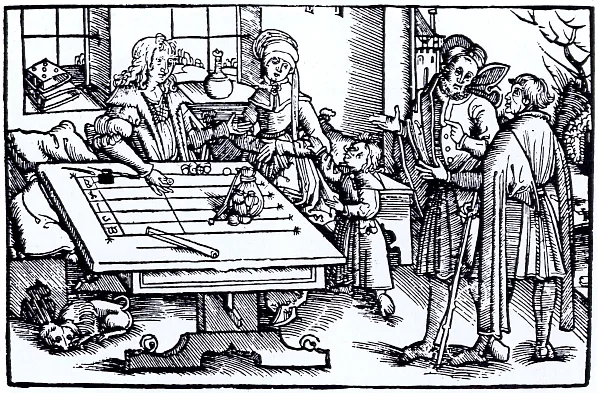
Asimismo, los estudios demuestran que tenían una finalidad muy concreta, pues eran utilizados eminentemente para realizar cuentas. Habitualmente se disponía sobre una mesa que tenía grabados una serie de valores (Figura 1), de modo que según donde se colocara cada pieza tenía uno u otro valor.
Figura 1. Mesa de cuentas. Dominio público. Fuente.
Historia de los jetones
Aunque hay testimonios de los jetones en Inglaterra desde mediados del siglo XII, la primera pieza conocida está a nombre de Blanca de Castilla (1188-1252), esposa de Luis VIII, madre y regente de Luis IX de Francia. Otros territorios fueron acuñando jetones, apareciendo en los señoríos colectivamente como Países Bajos y los territorios alemanes en el siglo XIV, en la región de Suiza en el siglo XVI; y el reino de Bohemia en el siglo XVII (Shärig, 2003, pp. 33-37).
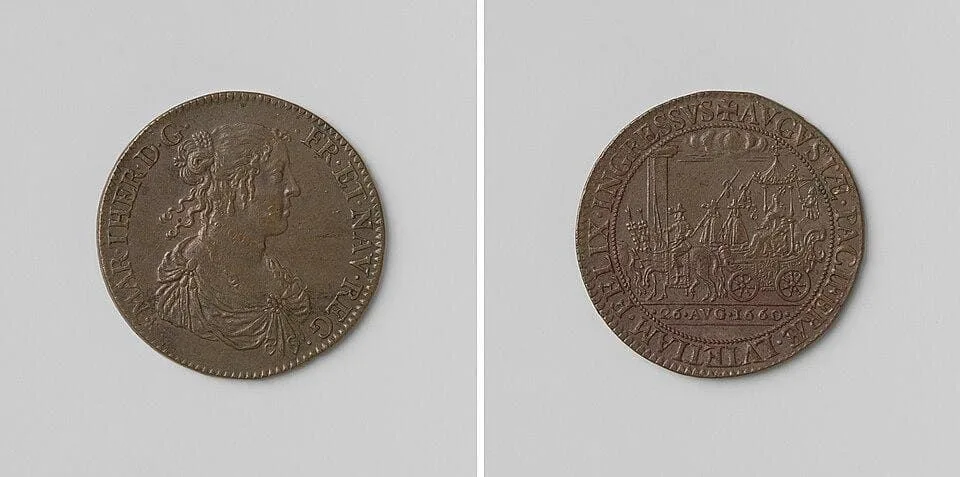
Si bien, aparecieron más tarde que en otros lugares, los jetones de Países Bajos destacaron tanto por el número de piezas que se acuñaron, como por la riqueza visual que llegaron a tener en la Alta Edad Moderna. A este respecto, cabe matizar parte de la definición de Ibáñez Artica, ya que los jetones siguieron acuñándose hasta el final de la Edad Moderna. Aun cuando a principios del siglo XVII no circulaba un número tan variado y con tanta riqueza visual, como se puede apreciar en jetones más sencillos a nombre de la emperatriz María Teresa (Figura 2), aún se acuñaron hasta los albores de la Edad Contemporánea. En el caso de Países Bajos, se acuñaron hasta que finales del siglo XVIII (Fernández Guisasola, 2026, p. 208-209).
Figura 2. Jeton conmemorativo del matrimonio de María Teresa de Austria, infanta de España, con Luis XIV de Francia. Dominio Público. Fuente.
Estudio de los jetones
En cierto sentido, el estudio de los jetones se asemeja al de las medallas, ya que en ambos casos se trata de piezas acuñadas por una persona con cierto prestigio, que elige unos tipos acorde a sus intereses particulares. Sin embargo, existen dos diferencias sustanciales: Primero, el grabador de medallas solía recibir un reconocimiento como artísta, mientras que los jetones no tienen ninguna marca que identifique a la persona encargada de su diseño. Segundo, las medallas se consideraban piezas de prestigio, que se acuñaban en un número muy limitado y solo servían para coleccionar (Beivide Pérez, 2026, pp. 43-45). En contraposición, y como ya se observó, los jetones tenían una finalidad práctica, y por ello se les presupone haber sido acuñados en mayor cantidad y haber tenido mayor capacidad de difusión en pequeños círculos comerciales.
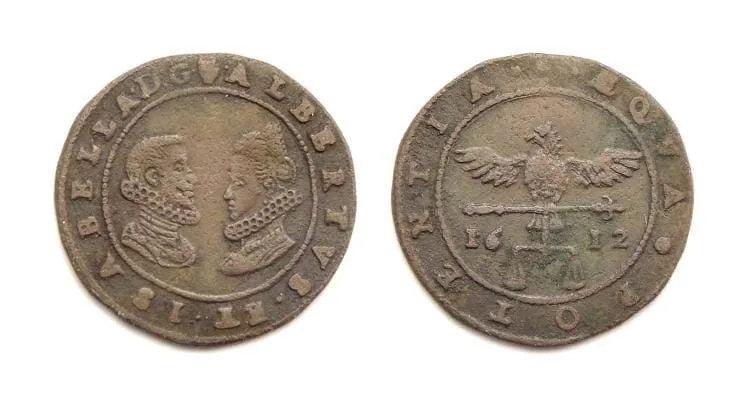
En el caso español resultan de especial interés los jetones acuñados en Países Bajos, por la historia común de ambos territorios (Figura 3). Se trata de un periodo del que se tiene una concepción sesgada por mitos historicistas que en ocasiones están muy alejados de la realidad histórica (Rodas Romero, 2023, 2024; Ortiz Izquierdo, 2024). La mayoría de estas piezas eran acuñadas por la Cámara de Finanzas, uno de los tres Consejo Colaterales que apoyaba la acción de gobierno (Schepper, 2018). Aunque también podían ser emitidos por particulares o el gobierno del norte. Los jetones de Países Bajos reflejan cómo ciertos eventos de esta época se vieron en esta época, desde el punto de vista neerlandés, como el advenimiento de la Casa de Austria, las disputas con Inglaterra en el siglo XVI o la Guerra de Sucesión Española (Fernández Guisaosla, 2026).
Figura 3. Jetón de los archiduques Alberto e Isabel Clara Eugenia, soberanos de Países Bajos. Creative Commons Attribution-Share Alike 3.0. Fuente.
Es relevante señalar que, a pesar de la valiosa información que se podrían obtener de estas piezas, apenas hay estudios al respecto. La obra de referencia sigue siendo el catálogo que hizo J. F. Dugniolle (1876-1880, 4. vols) en el siglo XIX, que aún no ha sido superado y obliga a cualquier persona interesada a tener que afrontar las carencias propias de los tratados de la época. Con este, se hace referencia a las descripciones de piezas que no terminan de encajar con las muestras existentes o tiene elementos mal identificados, ya sea por la pérdida de ejemplares tangibles o porque muchas veces la recapitulación se ha hecho a partir de testimonios. Aún así, se han hecho estudios de piezas concretas, como el jetón que se acuñó para hacer propaganda del pretendiente al trono inglés, Perkin Warbeck, quien afirmaba ser Ricardo de Shrewsbury, hijo desaparecido de Eduardo IV (Archivald y Dykes, 2020).
Conclusiones
En conclusión, los jetones son un objeto de uso cotidiano en entornos comerciales, pero que eran acuñados por las altas esferas institucionales o particulares. Esto supone que detrás de su iconografía hubiera un discurso propagandísitico, del mismo modo que ocurre con las monedas o las medallas. Por ello, son una fuente de estudio que aún no ha recibido la atención adecuada. Destacan los jetones de Países Bajos, tanto por cantidad, como por riqueza visual y especialmente porque muestran nuevos puntos de vista coetáneos sobre episodios históricos que se creen conocidos.
Bibliografía
Archivald, M. y Dykes, D. (2020). The medallic jetton of Perkin Warbeck. British Numismatic Journal, 90, 139–163.
Beivide Pérez, M. (2026). La heráldica como elemento identificativo en la medalla. Hidalguía: la revista de genealogía, nobleza y armas, 401, 41-65.
Dugniolle, J. F. (1876-1880). Le jeton historique des dix-sept provinces des Pays-Bas, 4 vols. R. Gobbaerts.
Fernández Guisasola, L. F. (2026). Los jetones, una fuente poco estudiada. Hidalguía: la revista de genealogía, nobleza y armas, 401, 191-212.
Francisco Olmos, J. M. (2026). La moneda, fuente básica en el estudio de la emblemática. Hidalguía: la revista de genealogía, nobleza y armas, 401, 213-236.
Ibáñez Artica, M. A. (2009). Jetones medievales con el escudo de Navarra, Trabajos de Arqueología, 25, 5-142.
Schärlig, A. (2003). Compter avec des jetons: tables à calculer et tables de compte du Moyen Age à la Révolution. Presses polytechniques et universitaires romandes.
Schepper, H. (2018). Los consejos «A latere principis u de su theniente generalŭ en el País Bajo de los Austrias, 1577/78-1609. Una presentación». Philostrato: revista de historia y arte, Extra 1, 11-40.
This translation was generated automatically using qwen2.5:14b-instruct and has not been reviewed by a human editor. It may contain errors, omissions or awkward phrasing — for the authoritative version, please read the original in Spanish. Found a mistake? Let us know at info@arqueotimes.es.
Tokens are coin-like objects minted during the Late Middle Ages and throughout the entire Modern Age, and the potential information that can be extracted from their iconographic study.
What are tokens?
In the words of Miguel Ángel Ibáñez Artica (2009, p. 3), tokens are defined as "metal pieces with a coin-like appearance, used to perform accounting operations during the Middle Ages and early Modern times."
It is important to note that while tokens may have a form and materials reminiscent of coins, they should never be confused with them. Coins can also be studied from an iconographic perspective; however, these are always backed by law (Francisco Olmos, 2026). As for tokens, they could be issued by the governing power or by individuals, but they are not regulated by any documentation and therefore do not have a completely legal value.
Furthermore, studies show that they had a very specific purpose, as they were primarily used to perform calculations. Typically, there was a table with engraved values (Figure 1), so the placement of each piece determined its value.
Although there are testimonies of tokens in England from the mid-12th century, the first known piece is named after Blanche of Castile (1188-1252), wife of Louis VIII and mother and regent of Louis IX of France. Other territories began minting tokens, appearing collectively in regions such as the Netherlands and German territories in the 14th century, Switzerland in the 16th century; and Bohemia in the 17th century (Shärig, 2003, pp. 33-37).
While they appeared later than in other places, tokens from the Netherlands stood out both for the number of pieces minted and for their visual richness during the High Modern Age. In this regard, it is worth clarifying part of Ibáñez Artica's definition, as tokens continued to be minted until the end of the Modern Age. Even though at the beginning of the 17th century there was not such a varied number and with so much visual richness, as can be seen in simpler tokens named after Empress Maria Theresa (Figure 2), they were still being minted up to the dawn of the Contemporary Era. In the case of the Netherlands, they continued to be minted until the end of the 18th century (Fernández Guisasola, 2026, p. 208-209).
Figure 2. Commemorative token of the marriage of Maria Theresa of Austria, Infanta of Spain, with Louis XIV of France. Public domain. Source.
Study of tokens
In a certain sense, the study of tokens resembles that of medals, as in both cases pieces are minted by someone with prestige who chooses types according to their particular interests. However, there are two substantial differences: First, the engraver of medals was often recognized as an artist, while tokens do not have any mark identifying the person responsible for their design. Second, medals were considered prestigious items that were minted in very limited numbers and only served for collecting (Beivide Pérez, 2026, pp. 43-45). In contrast, and as already observed, tokens had a practical purpose, and it is therefore assumed they were minted in greater quantities and had a wider distribution within small commercial circles.
In the Spanish case, tokens minted in the Netherlands are of particular interest due to the shared history between both territories (Figure 3). This period has a skewed perception influenced by historicist myths that are sometimes far from historical reality (Rodas Romero, 2023, 2024; Ortiz Izquierdo, 2024). Most of these pieces were minted by the Chamber of Finances, one of the three Councils that supported government action (Schepper, 2018). Although they could also be issued by individuals or the northern government. Tokens from the Netherlands reflect how certain events of this period were seen in this era, from a Dutch perspective, such as the advent of the House of Austria, disputes with England in the 16th century, or the War of Spanish Succession (Fernández Guisasola, 2026).
Figure 3. Token of Archdukes Albert and Isabella Clara Eugenia, sovereigns of the Netherlands. Creative Commons Attribution-Share Alike 3.0. Source.
It is important to note that, despite the valuable information that could be obtained from these pieces, there are few studies on them. The reference work remains J.F. Dugniolle's (1876-1880, 4 vols) catalog in the 19th century, which has yet to be surpassed and forces anyone interested to confront its own limitations of the time. With this catalog, there are references to descriptions of pieces that do not quite fit with existing samples or have elements misidentified, either due to the loss of tangible examples or because many times the recapitulation was done based on testimonies. Nevertheless, studies of specific pieces have been conducted, such as the token minted for propaganda purposes for Perkin Warbeck, who claimed to be Richard of Shrewsbury, a missing son of Edward IV (Archivald and Dykes, 2020).
Conclusions
In conclusion, tokens were everyday objects used in commercial environments but minted by high-level institutions or individuals. This implies that behind their iconography there was a propagandistic discourse, much like with coins and medals. Therefore, they are a source of study that has yet to receive adequate attention. Tokens from the Netherlands stand out for quantity, visual richness, and especially because they show contemporary perspectives on historical events believed to be well-known.
Bibliography
Archivald, M. and Dykes, D. (2020). The medallic jetton of Perkin Warbeck. British Numismatic Journal, 90, 139–163.
Beivide Pérez, M. (2026). Heraldry as an Identifying Element in the Medal. Hidalguía: the journal of genealogy, nobility and arms, 401, 41-65.
Dugniolle, J. F. (1876-1880). The Historical Token of the Seventeen Provinces of the Netherlands, 4 vols. R. Gobbaerts.
Fernández Guisasola, L. F. (2026). Tokens: A Little-Studied Source. Hidalguía: the journal of genealogy, nobility and arms, 401, 191-212.
Francisco Olmos, J. M. (2026). The Coin as a Basic Source in Emblematic Study. Hidalguía: the journal of genealogy, nobility and arms, 401, 213-236.
Ibáñez Artica, M. A. (2009). Medieval Tokens with the Shield of Navarre, Archaeological Studies, 25, 5-142.
Schärlig, A. (2003). Counting with Tokens: Calculation and Account Tables from the Middle Ages to the Revolution. Presses polytechniques et universitaires romandes.
Schepper, H. (2018). The Councils "A latere principis u de su theniente generalŭ in the Low Country of the Austrias, 1577/78-1609. A Presentation". Philostrato: journal of history and art, Extra 1, 11-40.
Fernandez Guisasola, L. F. (2026, 29 de junio). Los jetones, pequeñas fichas con una gran historia. ArqueoTimes. https://arqueotimes.com/articulos/los-jetones-pequenas-fichas-con-una-gran-historia/




Comentarios