El origen del cristianismo se desarrolló en la intersección de tres continentes y estuvo influenciado por la presencia de dos grandes imperios como eran el Imperio Romano y el Imperio Parto. Los primeros seguidores de Jesús se expandieron en todas direcciones con el fin de divulgar la palabra de Cristo a todos los pueblos del mundo. En la zona de Asia bajo influencia romana, los cristianos eran perseguidos, no debido a sus características religiosas, sino ante su negativa a la hora de adorar al culto imperial, uno de los principales pilares del Estado Romano. Por el contrario, en los territorios orientales, las primeras comunidades cristianas se desarrollaron con mayor facilidad debido a las políticas más tolerantes y abiertas hacia las distintas culturas y religiones que convivían en territorio parto.
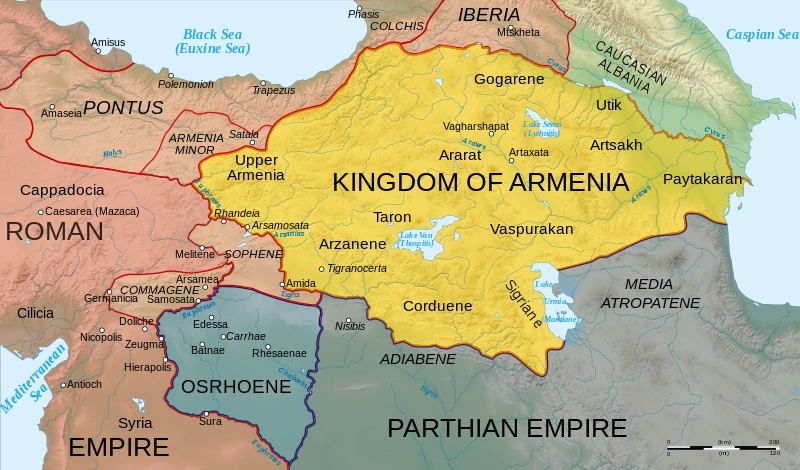
Entre el Imperio Romano y el Imperio Parto se situaban una serie de reinos menores que tenían cierto grado de independencia, aunque estaban muy influenciados por las grandes potencias que los acechaban. Uno de estos reinos era el reino de Osroene, cuya capital era la ciudad de Edesa y su rey, el mítico Abgar V.
Figura 1: Situación fronteriza entre el Imperio Romano y el Imperio Parto en el siglo I. Fuente.
El primer testimonio que tenemos sobre esta historia se encuentra en la obra Historia de la Iglesia de Eusebio de Cesarea, realizada en la primera mitad del siglo IV. Según la tradición iniciada por Eusebio, Abgar sufría de una enfermedad incurable de la piel y conoció la historia de un hombre santo que estaba realizando sanaciones aparentemente imposibles en Jerusalén. El monarca de Edesa, desesperado por encontrar una cura, decidió mandarle una carta a Jesús dónde le invitaba a su ciudad para que le sanase y a su vez le ofrecía la mitad de su reino, ya que habían llegado a sus oídos que los judíos estaban conspirando contra él. Jesús recibió la carta y consideró a Abgar digno de recibir una respuesta. En ésta, Jesús rechazaba la oferta del rey ya que afirmaba que aún tenía una misión que cumplir. No obstante, le prometió que mandaría a uno de sus seguidores, Tadeo, para que le sanase. Además, en algunas tradiciones posteriores, también bendijo a la ciudad de Edesa para que ningún enemigo pudiera conquistarla jamás (Guscin, 2009:1-4).
Una vez que se produjo la Ascensión, Tadeo llegó a la ciudad siria y realizó varias sanaciones milagrosas, entre ellas la del rey Abgar. Sin embargo, su misión no terminó ahí sino que también evangelizó al reino sirio, hecho bastante importante ya que según esta tradición apócrifa el reino de Osroene se convirtió en el primer Estado cristiano de la historia.
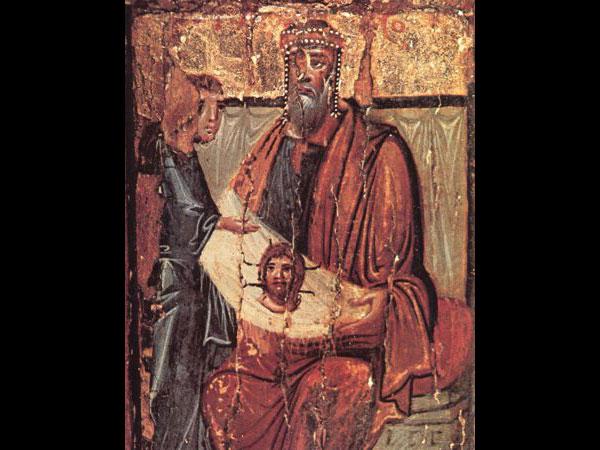
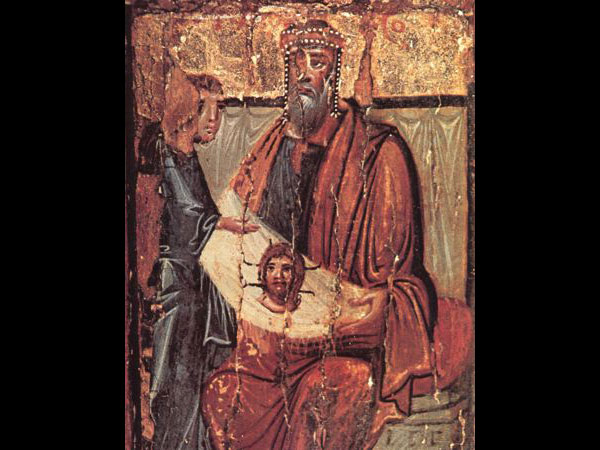
Figura 2: El legendario Abgar V con la imagen sagrada de Edesa. Fuente.
El valor apotropaico de la leyenda
La popularidad de esta tradición se basó en gran medida en que se trataba de un relato que afirmaba tener un escrito realizado por el mismo Jesús. Además, en su respuesta bendecía a la ciudad siria, elemento que tuvo una gran importancia en la cosmovisión de los ciudadanos de Edesa que necesitaban cualquier tipo de ayuda, incluso divina, para afrontar los continuos asedios a los que se veían sometidos debido a la importancia geoestratégica de la ciudad.
Poco a poco, este valor mistérico, sagrado e incluso mágico fue calando entre la sociedad de la época pese a que la correspondencia había sido declarada como apócrifa por el Decretum Gelasianum del 494 (Gurinov, 2019:84-114). El intercambio de cartas entre Jesús y Abgar se había convertido en el episodio más popular de toda la leyenda. El texto contenido en esta correspondencia, especialmente la respuesta de Jesús, fue inscrito en numerosos soportes por todo el mundo cristiano con una finalidad claramente apotropaica, hecho que sin duda favoreció el desarrollo y la pervivencia de esta tradición.
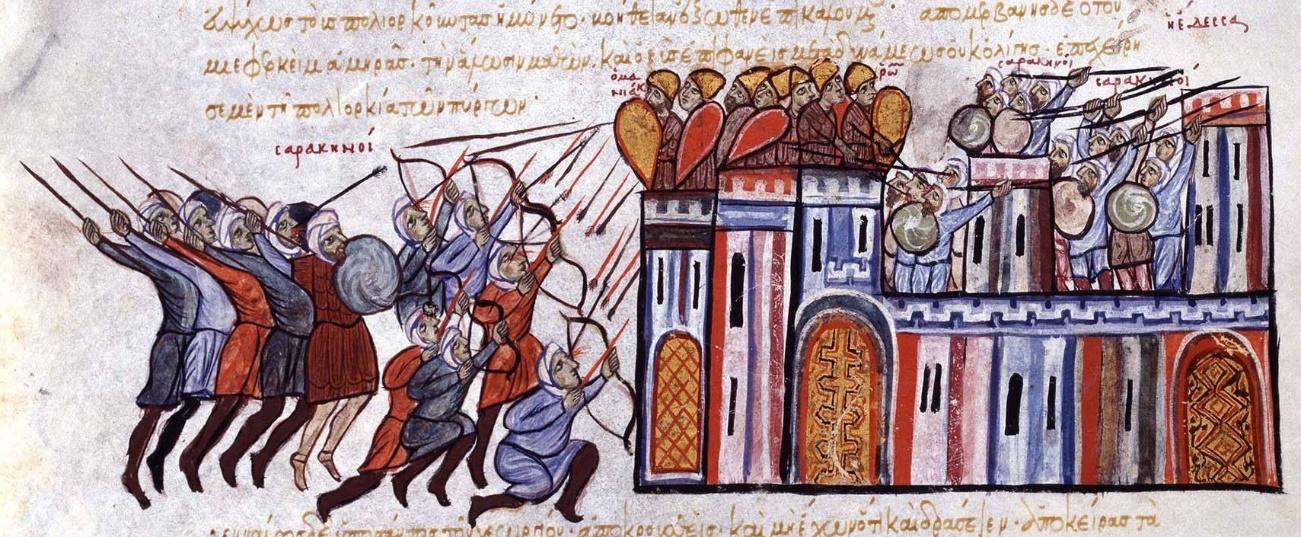
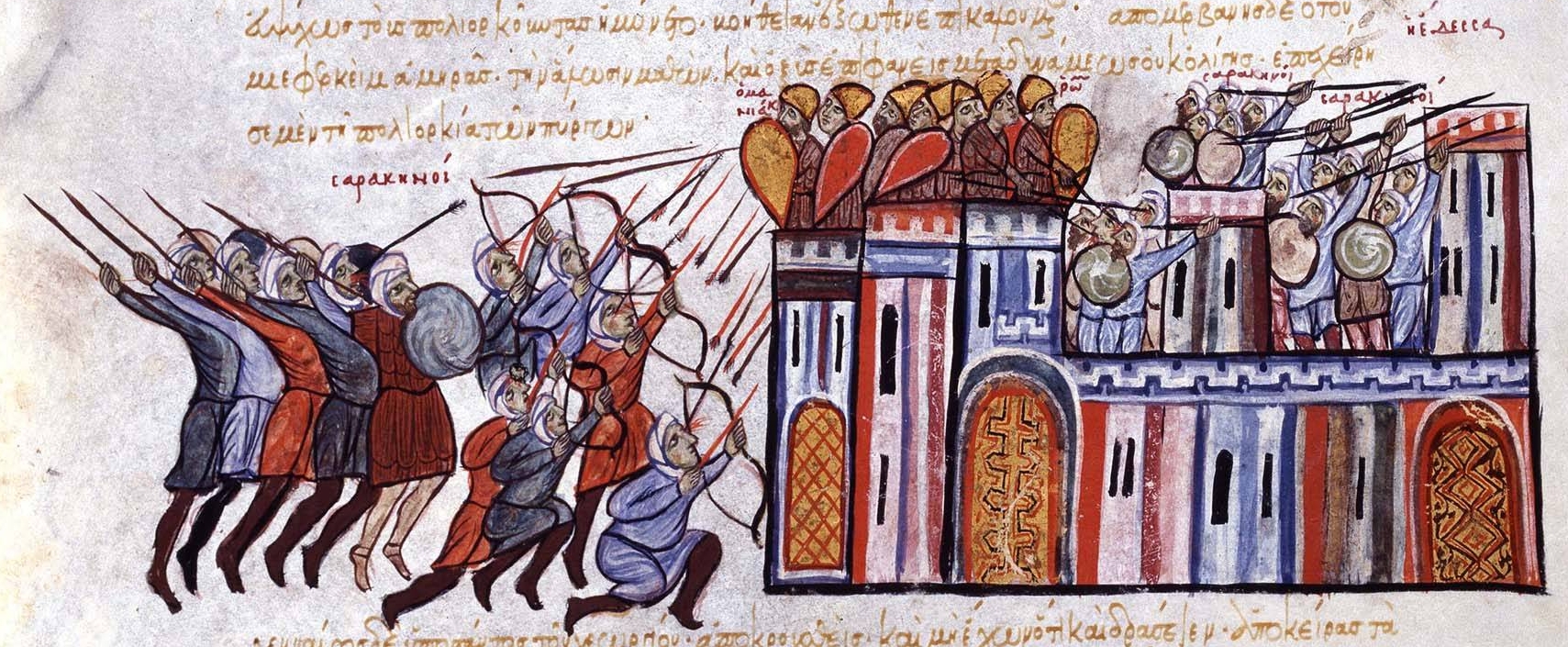
Figura 3: Defensa de la ciudad de Edesa ante el asedio musulmán. Fuente.
Dentro de los testimonios que han llegado a nosotros sobre esta leyenda, existen dos ejemplos que demuestran a la perfección la derivación mágica que sufrió la leyenda de Abgar y Jesús.
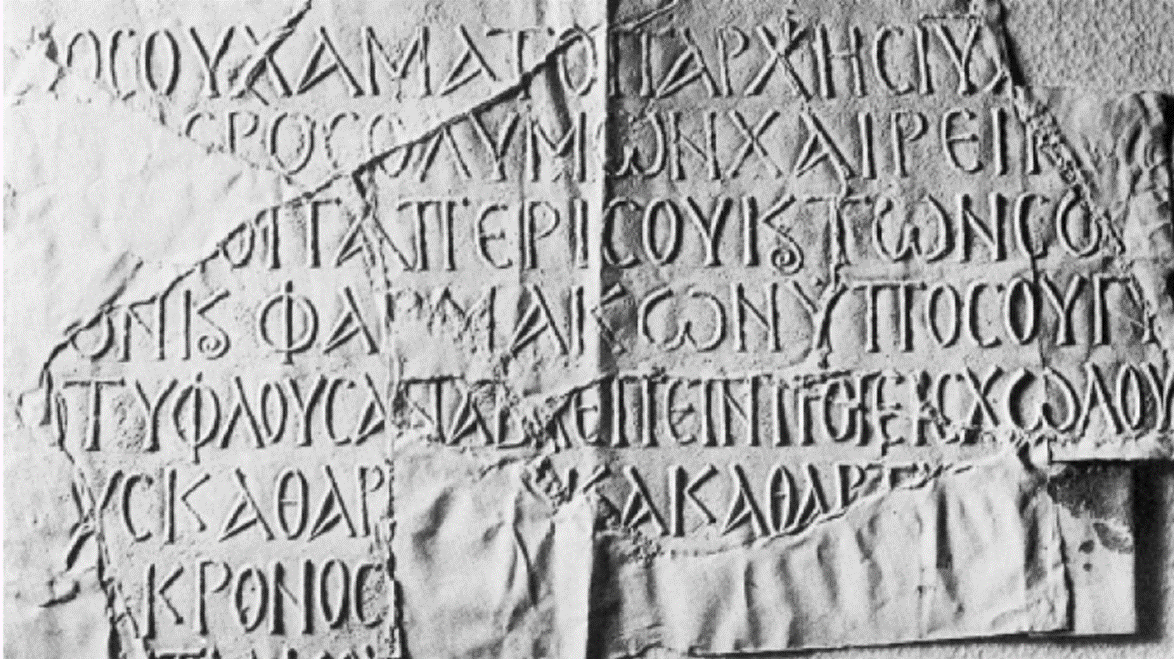
El primero se trata de la inscripción encontrada en la ciudad de Filipos (Macedonia), datada en torno al s. V. La inscripción presenta ambas cartas y se encontró en la puerta de la antigua muralla. Varios investigadores afirman que el lugar en donde fue encontrada la inscripción tiene gran importancia debido a que posiblemente los autores intentaron reflejar la bendición divina de Cristo sobre su propia ciudad. No obstante, este hecho puede resultar un tanto extraño ya que, en las cartas, la bendición sagrada iba dirigida solamente a Edesa y no a otro lugar. Sin embargo, esto es un caso muy común dentro de la cristiandad, ya que lugares con un gran simbolismo como el Santo Sepulcro se han reproducido en lugares totalmente distintos a su lugar de origen. Por tanto, los individuos que realizaron la inscripción conocían a la perfección la tradición de la correspondencia e hicieron su obra intentando establecer un paralelismo simbólico (Lidov, 2007:195-212).
Figura 4: Inscripción epigráfica de la correspondencia entre Jesús y Abgar en la ciudad de Filipos (S. V). Fuente: Picard, C. (1920) «Un texte nouveau de la correspondance entre Abgar d’Osroène et Jésus-Christ gravé sur une porte de ville, à Philippes (Macédoine)». Bulletin de correspondance hellénique XLIV.
Por otro lado, tenemos el caso de un pergamino preservado en la Imperial Library of Vienna, el Cod. Theol, graec. 315, editado por Lipsius y datado en la segunda mitad del siglo V, algunos años después del Concilio de Calcedonia (Gottheil, 1891:268-277). El fin con el que está realizado este papiro es perfectamente reflejado en las primeras líneas:
«Dondequiera que se presente esto, mi epístola, ya sea en el proceso o en los tribunales, ya sea en el camino o en el mar, ya sea con los que tienen escalofríos o con los que tienen fiebre o con los que tiemblan por la fiebre o los que están excitados o aquellos quienes estén encantados con un nudo mágico o drogados o todo lo que sea similar a estas (cosas), será liberado».
Como se puede observar en los ejemplos anteriores, lo que fue en un origen un texto literario evolucionó hacía un uso mágico derivado del gran poder que se le daba a unas palabras que supuestamente habían sido escritas o mencionadas por el mismo Jesús.
Conclusiones
A modo de conclusión de este trabajo, me gustaría destacar las principales ideas que se han ido reflejando a lo largo de su desarrollo. Sobre el origen de esta leyenda, hay diversas teorías que apuntan a que Eusebio de Cesarea realizó su obra con fines apologéticos y tergiversó los orígenes «heréticos» del cristianismo en Edesa (Corke-Webster, 2017:563-587). La finalidad del autor habría sido crear una nueva imagen de Jesús y el cristianismo entre la sociedad del s. IV y acabar con las críticas paganas.
De este modo, se explicaría el por qué no nos ha llegado ninguna fuente anterior a la obra de Eusebio a pesar de que éste afirmaba que había tomado la información de los archivos reales de Edesa y simplemente se había encargado de realizar una traducción al griego para facilitar la divulgación por el mundo cristiano. Sea cual fuese su origen, es innegable el hecho de que este texto literario fue utilizado como elemento apotropaico. Este fenómeno puede verse debido a la consideración del gran poder que guardaba un escrito realizado por el mismo Jesús. Las modificaciones y variaciones que fue sufriendo la leyenda a lo largo de los siglos estuvieron destinadas en todo momento en focalizar y fomentar el uso mágico de la correspondencia.
El caso de la derivación mágica de esta tradición apócrifa no es un caso aislado, ya que hay varios ejemplos de uso de fragmentos de la Ilíada y de la Odisea con fines mágicos (Collins, 2008:104-131). Además, hay varios casos de textos bíblicos judíos que fueron utilizados para evitar el mal de ojo y entidades demoníacas (Bohak, 2019:70-122). Por tanto, se puede establecer la hipótesis de que la tradición apócrifa neotestamentaria de Abgar y Jesús responde a una tradición sincrética mágica bien establecida y desarrollada.
BIBLIOGRAFÍA
Bohak, G. (2019) Babylonian Jewish Magic in Late Antiquity: Beyond the Incantation Bowls.En Y.Friedmann y E. Kohlberg, E. (eds.) Studies in Honor of Shaul Shaked (70-122).Jerusalem: The Israel Academy of Sciences and Humanities.
Collins, D. (2008) Magic in Ancient Greek World. Oxford: Blackwell Publishing Ltd.
Corke-Webster, J. (2017). A Man for the Times: Jesus and the Abgar Correspondence in Eusebius of Cesarea’s Ecclesiastical History”, HTR 110,4, 563-597.
Gottheil, R.J. H. (1891). An Arabic Version of the Abgar-Legend, Hebraica, 268-277.
Gurinov, E. (2019) The Blessed City: Edessa and the Abgar Legend in the Age of the Crusades. En O. Keller (ed.) Opere et Veritate: Sammelband von wissenschaftlichen Werken, gewidmet dem 10-jährigen Jubiläum der Zusammenarbeit zwischen den Historikern von weißrussischen Universitäten und der Universität Tübingen (84-114). Minsk:RIVSH
Guscin, M. (2009) The Image of Edessa. Leiden:Brill.Lidov, A. (2007) Holy Face, Holy Script, Holy Gate. Revealing the Edessa Paradigm in Christian Imagery. En A. R. Calderoni, G. Wolf y C. B. Dufour (eds.) Intorno al Sacro Volto. Genova, Bisanzio e il Mediterraneo (secoli XI-XIV)(195-212). Venezia: Marsilio.
This translation was generated automatically using qwen2.5:14b-instruct and has not been reviewed by a human editor. It may contain errors, omissions or awkward phrasing — for the authoritative version, please read the original in Spanish. Found a mistake? Let us know at info@arqueotimes.es.
Introduction
The origin of Christianity developed at the intersection of three continents and was influenced by the presence of two great empires, namely the Roman Empire and the Parthian Empire. The early followers of Jesus spread in all directions with the aim of disseminating the word of Christ to all peoples of the world. In the region of Asia under Roman influence, Christians were persecuted not due to their religious characteristics but because of their refusal to worship the imperial cult, one of the main pillars of the Roman State. Conversely, in eastern territories, the first Christian communities developed more easily due to the more tolerant and open policies towards different cultures and religions that coexisted in Parthian territory.
Between the Roman Empire and the Parthian Empire lay a series of minor kingdoms that had some degree of independence, although they were heavily influenced by the great powers surrounding them. One of these kingdoms was the kingdom of Osroene, whose capital was the city of Edessa and its king, the legendary Abgar V.
Figure 1: Border situation between the Roman Empire and the Parthian Empire in the first century. Source.
The first testimony we have about this story is found in the work Ecclesiastical History by Eusebius of Caesarea, written in the first half of the fourth century. According to the tradition initiated by Eusebius, Abgar suffered from an incurable skin disease and learned about a holy man who was performing seemingly impossible healings in Jerusalem. The king of Edessa, desperate to find a cure, decided to send him a letter to Jesus inviting him to his city to be healed, and at the same time offered him half of his kingdom since he had heard that the Jews were conspiring against him. Jesus received the letter and considered Abgar worthy of receiving an answer. In this one, Jesus rejected the king's offer since he claimed that he still had a mission to fulfill. Nevertheless, he promised to send one of his followers, Thaddeus, to heal him. Additionally, in some later traditions, he also blessed the city of Edessa so that no enemy could conquer it ever (Guscin, 2009:1-4).
Once the Ascension took place, Thaddeus arrived in the Syrian city and performed several miraculous healings, including that of King Abgar. However, his mission did not end there but also evangelized the Syrian kingdom, an event of great importance since according to this apocryphal tradition the kingdom of Osroene became the first Christian state in history.
Figure 2: The legendary Abgar V with the sacred image of Edessa. Source.
The apotropaic value of the legend
The popularity of this tradition was based largely on the fact that it was a story claiming to have been written by Jesus himself. Furthermore, in his response he blessed the Syrian city, an element that had great importance in the worldview of Edessa's citizens who needed any kind of help, even divine, to face the continuous sieges they were subjected to due to the strategic importance of the city.
Gradually, this mystical, sacred, and even magical value permeated society despite the correspondence having been declared apocryphal by the Gelasian Decree in 494 (Gurinov, 2019:84-114). The exchange of letters between Jesus and Abgar had become the most popular episode of the entire legend. The text contained in this correspondence, especially Jesus' response, was inscribed on numerous supports throughout the Christian world with a clearly apotropaic purpose, which undoubtedly favored the development and persistence of this tradition.
Figure 3: Defense of the city of Edessa against the Muslim siege. Source.
Among the testimonies that have reached us about this legend, there are two examples that perfectly demonstrate the magical derivation that the Abgar and Jesus legend underwent.
The first is an inscription found in the city of Philippi (Macedonia), dating from around the 5th century. The inscription presents both letters and was found at the gate of the ancient wall. Several researchers claim that the place where the inscription was found has great importance because the authors possibly intended to reflect the divine blessing of Christ on their own city. However, this fact may seem somewhat strange since in the letters, the sacred blessing was directed solely to Edessa and not elsewhere. Nevertheless, this is a common occurrence within Christianity, as places with significant symbolism such as the Holy Sepulchre have been reproduced in entirely different locations from their place of origin. Therefore, those who made the inscription were well aware of the tradition of correspondence and created their work attempting to establish a symbolic parallelism (Lidov, 2007:195-212).
Figure 4: Epigraphic inscription of the correspondence between Jesus and Abgar in the city of Philippi (5th century). Source: Picard, C. (1920) «Un texte nouveau de la correspondance entre Abgar d’Osroène et Jésus-Christ gravé sur une porte de ville, à Philippes (Macédoine)». Bulletin de correspondance hellénique XLIV.
On the other hand, we have the case of a parchment preserved in the Imperial Library of Vienna, Cod. Theol, graec. 315, edited by Lipsius and dated to the second half of the fifth century, some years after the Council of Chalcedon (Gottheil, 1891:268-277). The purpose for which this papyrus was made is perfectly reflected in the first lines:
"Wherever this appears, my epistle, whether in court or tribunal, whether on the road or at sea, whether with those who have chills or with those who have fever or tremble from fever or are agitated or are bound by magic knots or drugged or anything similar to these (things), will be released."
As can be seen in the previous examples, what was originally a literary text evolved towards a magical use derived from the great power attributed to words supposedly written or mentioned by Jesus himself.
Conclusions
As a conclusion of this work, I would like to highlight the main ideas that have been reflected throughout its development. Regarding the origin of this legend, there are various theories pointing to Eusebius of Caesarea having written his work with apologetic purposes and distorted the origins "heretical" of Christianity in Edessa (Corke-Webster, 2017:563-587). The author's aim would have been to create a new image of Jesus and Christianity among the society of the fourth century and end pagan criticisms.
In this way, it explains why no source prior to Eusebius' work has reached us despite his claim that he had taken information from Edessa's royal archives and simply translated it into Greek for easier dissemination throughout the Christian world. Regardless of its origin, it is undeniable that this literary text was used as an apotropaic element. This phenomenon can be seen due to the great power attributed to a written document by Jesus himself. The modifications and variations that the legend underwent over centuries were always aimed at focusing on and fostering the magical use of correspondence.
The case of the magical derivation of this apocryphal tradition is not an isolated one, as there are several examples of using fragments of the Iliad and Odyssey for magical purposes (Collins, 2008:104-131). Additionally, there are several cases of Jewish biblical texts used to ward off the evil eye and demonic entities (Bohak, 2019:70-122). Therefore, it can be hypothesized that the apocryphal Neotestamentary tradition of Abgar and Jesus responds to a well-established and developed syncretic magical tradition.
BIBLIOGRAPHY
Bohak, G. (2019) Babylonian Jewish Magic in Late Antiquity: Beyond the Incantation Bowls. In Y.Friedmann and E. Kohlberg, E. (eds.) Studies in Honor of Shaul Shaked (70-122). Jerusalem: The Israel Academy of Sciences and Humanities.
Collins, D. (2008) Magic in Ancient Greek World. Oxford: Blackwell Publishing Ltd.
Corke-Webster, J. (2017). A Man for the Times: Jesus and the Abgar Correspondence in Eusebius of Caesarea’s Ecclesiastical History”, HTR 110,4, 563-597.
Gottheil, R.J. H. (1891). An Arabic Version of the Abgar-Legend, Hebraica, 268-277.
Gurinov, E. (2019) The Blessed City: Edessa and the Abgar Legend in the Age of the Crusades. In O. Keller (ed.) Opere et Veritate: Sammelband von wissenschaftlichen Werken, gewidmet dem 10-jährigen Jubiläum der Zusammenarbeit zwischen den Historikern von weißrussischen Universitäten und der Universität Tübingen (84-114). Minsk:RIVSH
Guscin, M. (2009) The Image of Edessa. Leiden:Brill.Lidov, A. (2007) Holy Face, Holy Script, Holy Gate. Revealing the Edessa Paradigm in Christian Imagery. In A. R. Calderoni, G. Wolf and C. B. Dufour (eds.) Intorno al Sacro Volto. Genova, Bisanzio e il Mediterraneo (secoli XI-XIV)(195-212). Venezia: Marsilio.
Lopez Calero, S. (2022, 24 de octubre). Protección ante la adversidad: un acercamiento hacia el valor mágico de la leyenda de Abgar. ArqueoTimes. https://arqueotimes.com/articulos/proteccion-ante-la-adversidad-un-acercamiento-hacia-el-valor-magico-de-la-leyenda-de-abgar/





Comentarios