Asistir en directo a una de las últimas propuestas de Abraham Cupeiro, no es solo acudir a un concierto. Es sumergirte en la memoria y la cultura de la humanidad. El espectáculo presentado por el musicólogo junto a la Real Orquesta Sinfónica de Sevilla (ROSS), de la mano de su director Alejandro Muñoz, creó un lienzo sobre el que se proyectaron algunos sonidos recuperados del olvido y del pasado.
¿Quién es Abraham Cupeiro? La figura central de este proyecto es músico, musicólogo e investigador cuya trayectoria ha sido plenamente significativa. Formado en el Real Conservatorio Superior de Música de Madrid, con especialidad en instrumento de viento-metal, posteriormente profundizó en la sonoridad de la antigüedad cursando el máster en Interpretación de la Música Antigua por la Universidad Autónoma de Barcelona. Sumado a esto, desde pequeño mostró gran interés en los instrumentos gracias a sus raíces y en especial a su abuelo, según ha expresado nuestro protagonista en algunas entrevistas.
La dedicación, esfuerzo e investigación han permitido que su carrera alcance calado internacional, como su proyecto orquestal ‘Pangea’ o ‘Los Sonidos Olvidados’ donde reconstruye y da vida a instrumentos milenarios de la antigüedad. Además, ha formado parte del repertorio sonoro de ‘Gladiator 2’, colaborando con la compañía de Hams Zimmer.
Con ‘Mythos’ (2024-2025), Cupeiro, también conocido como el arqueólogo musical, consolida su proyección sinfónica internacional, colaborando con formaciones de la altura de la Royal Philharmonic, la Oviedo Filarmonía y, de manera excepcional, en esta ocasión, con la Real Orquesta Sinfónica de Sevilla (ROSS).
Al comenzar, la experiencia no se limita a un plano musical indefinido, sino que antes de cada sección programada el compositor articula un discurso narrativo. Así, el espectador se sitúa en el contexto histórico de cada obra, logrando incluso que, al cerrar los ojos, pueda trasladarse a las vivencias de las civilizaciones remotas.
El orgullo y castigo divino encabeza la primera experiencia con ‘Requiem por Marsias’, inspirada en el enfrentamiento con el dios Apolo. A través de la música simboliza la fragilidad humana mediante el sonido del aulós, uno de los instrumentos más importantes del mundo antiguo. Este se compone de dos tubos separados con lengüetas dobles independientes y distintos orificios, perteneciendo a la misma familia organológica del clarinete o el oboe (Jiménez et al, 2021a, p.144).
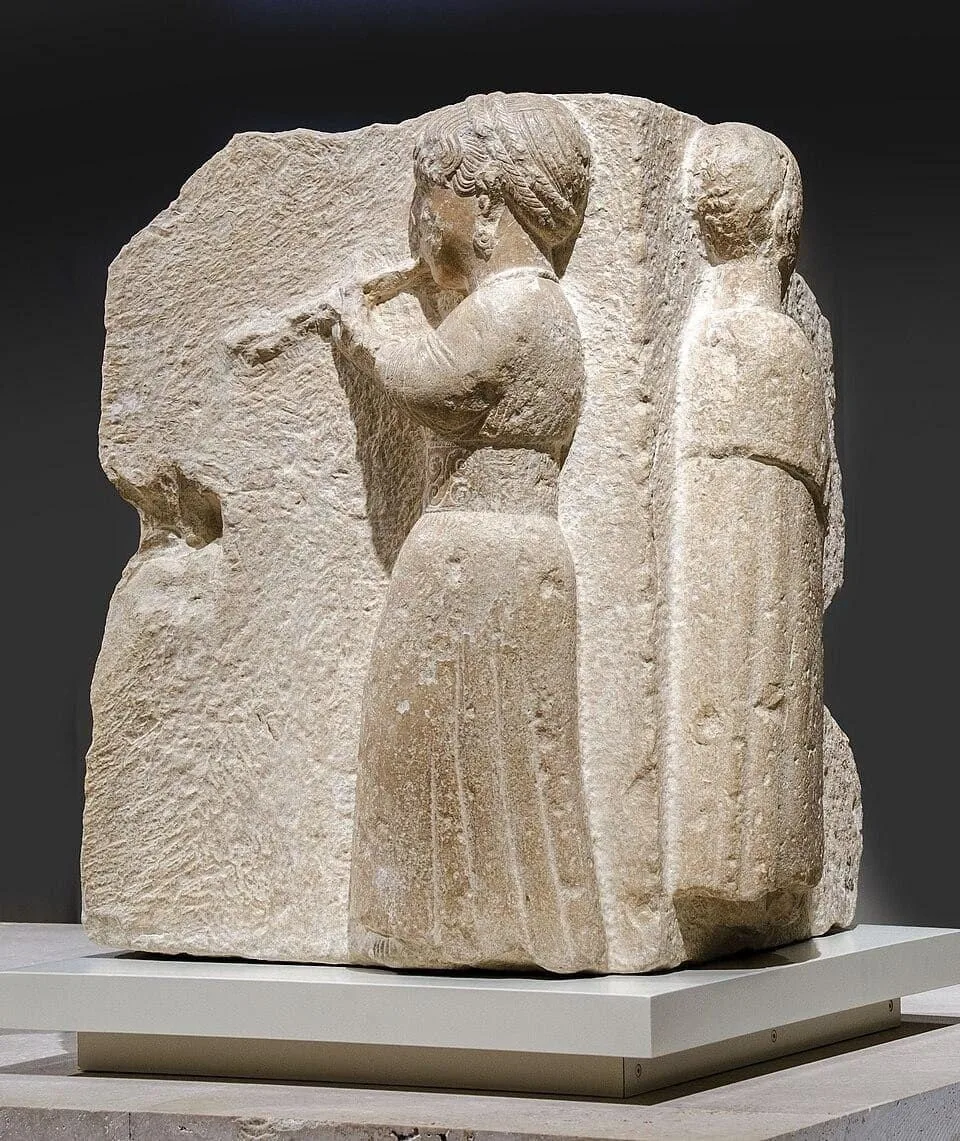
Trascendemos de lo puramente musical a la evidencia arqueológica, destacando el fragmento del Museo Arqueológico Nacional documentado en el trabajo de Jiménez Pasalodos et al (2021). El único hallazgo documentado de tipología helenística en la península ibérica, procedente del yacimiento de Cabezo de Alcalá (Teruel). Y recordando la puesta en escena de nuestro compositor, perpetuamos la representación de una mujer ‘Auletris’ en el relieve ibérico de Osuna (Sevilla), evidenciando que se adaptó a las prácticas culturales locales durante la antigüedad.
Figura 1. Auletris de Osuna (Sevilla), Museo Arqueológico Nacional (MAN). Reproducción con licencia CC BY 2.0. Autor: A. M. Felicísimo, 2016. Fuente.
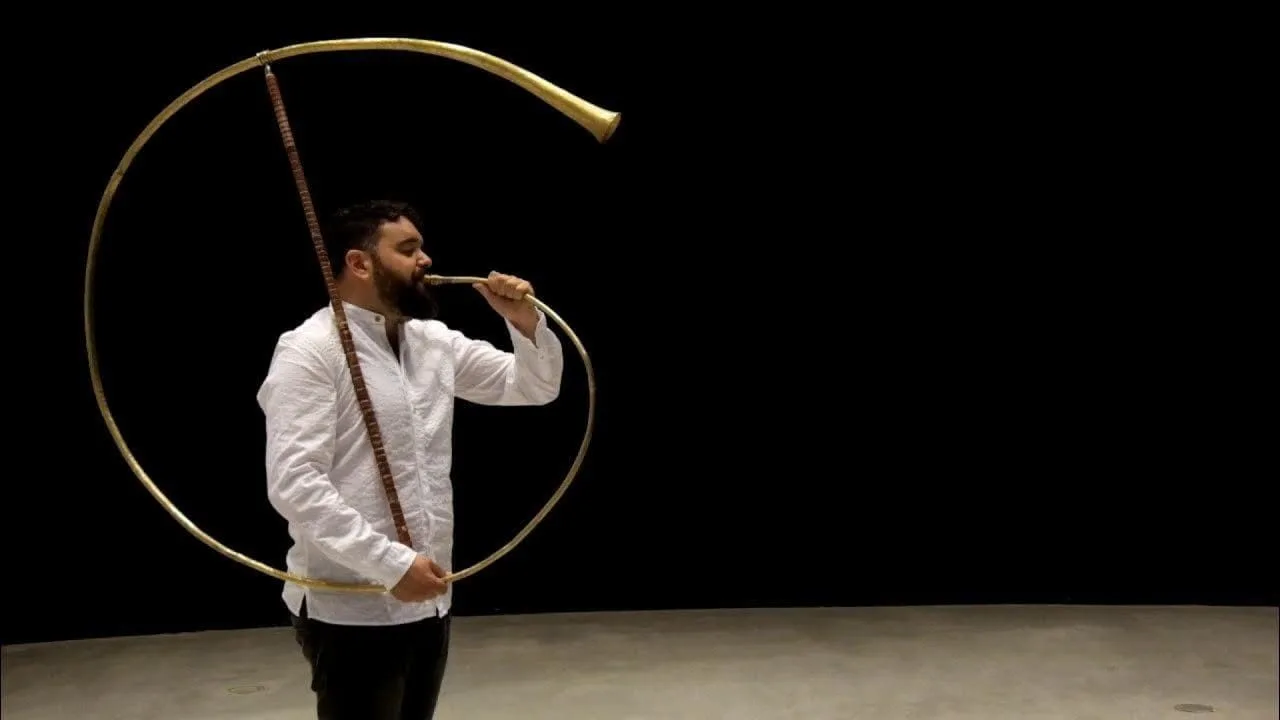
Seguido ‘Plegarias a Minerva’, donde te hace sentir como en un espacio de introspección bélica, inundan la sala a través del sonido. A través del cornu, instrumento de grandes dimensiones con forma de G usado para controlar las tropas, nos sumerge en el deber y la esperanza de victoria en el contexto romano. En este caso, el usado ha sido construido por María Ruíz y Abraham Cupeiro basándose fielmente en los cornus hallados en Pompeya en las excavaciones del siglo XIX (Cupeiro, 2017).
Figura 2. Cupeiro tocando el cornus. Fuente: Youtube, Abraham Cupeiro, 2017. Licencia: Abraham Cupeiro.
Pasando por Oriente con ‘La leyenda de Simurgh’, es narrado que a pesar del rechazo de Zal, la mítica ave Simurgh, es la figura de protección que a través de la música une el mundo místico y humano. Para los oyentes, el ‘ney persa’, es el instrumento que en esta melodía despliega sus alas hasta lo más profundo de la cultura persa.
Como curiosidad, es uno de los instrumentos que usó nuestro compositor para la grabación de la banda sonora de Gladiator 2 (El Progreso de Lugo, 2024). Además, este instrumento milenario fue objeto de estudio fotográfico y etnográfico registrado en el ‘Álbum de Turquestán’ en la década de 1890. En la sección etnográfica (1872, parte 2, volumen 1), la lámina 82 (nº268) bajo el título ‘Pastimes of Central Asians. A Musician Playing a Nai, a flute-like instrument’, ofrece una evidencia visual de la vigencia de este instrumento, donde a pesar del paso del tiempo, la tradición y la música han formado parte de la historia del continente oriental. Esta referencia transforma a su vez la interpretación por parte de Cupeiro, como puente de justicia histórica, devolviéndole sonido a la imagen capturada hace más de un siglo.
Hacia el tramo final de la experiencia el repertorio alcanza su plenitud al proyectarse hacia el cosmos con ‘El océano cósmico y el señor de la Danza’, que nos abre las puertas al mundo de la mitología india, donde la danza de Shiva procura la creación, preservación y destrucción del universo. Seguidamente, ‘La cierva blanca’ nos sumerge en una historia mitológica que permaneció siempre en la memoria del pueblo irlandés, gracias a la dulce sonoridad que produce con la ‘flauta irlandesa’ y la gaita de tipo ‘uilleann’.
Como cláusula, ‘Atlantis’, la ciudad sumergida y desconocida simboliza una alegoría sobre la historia de las civilizaciones. La mítica ciudad sirve como reflejo para reflexionar ante el patrimonio y la preservación de la naturaleza en nuestros días. Para invocar al pasado más remoto, Cupeiro usa la concha como el aerófono más antiguo de las civilizaciones, conectándonos con el océano y el inicio de la vida. Sin embargo, el carnyx,propio de la Edad del Hierro,adquiere un papel importante, pues en manos de Abraham deja de ser una pieza museística para convertirse en un sonido vivo, vibrante sobre todo el auditorio, que nos insta a proteger el legado sonoro.
En definitiva, Mythos no es solo un proyecto más, sino la unión de otros trabajos anteriores en los que ha integrado todo el esfuerzo vital. Si en sus primeras obras trataba de rescatar el sonido de instrumentos olvidados (Los Sonidos Olvidados, Warner Classics, 2017), aquí logra integrar la historia de las civilizaciones en una narrativa universal, la música.
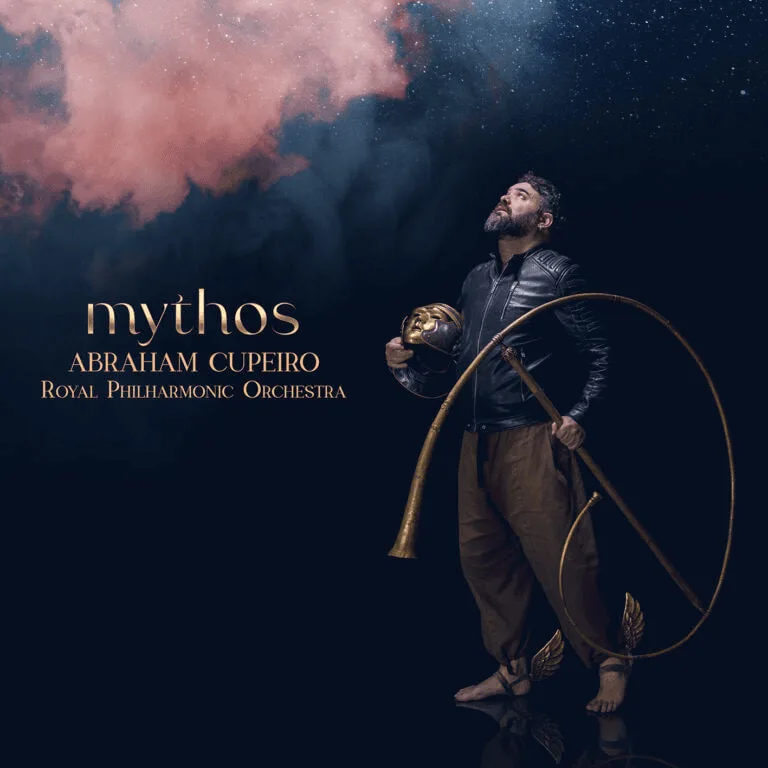
Figura 3. Fuente: Abraham Cupeiro. Licencia: Abraham Cupeiro
Su capacidad de transformar instrumentos silenciados (mediante la arqueología experimental) en voces que gritan para celebrar la diversidad cultural en el tiempo lo consolidan como el ‘arqueólogo de la música’. Ciertamente, nuestro multiintrumentalista crea una pieza significativa en la arqueología de la música, pues a partir de evidencias materiales de contextos arqueológicos construye organológicamente los sonidos. También en la etnoarqueología, manteniendo interés en los instrumentos musicales de las sociedades vivas conservando costumbres primitivas (Jiménez et al, 2021b, p. 19; Ortiz García-Blanco, 2025).
Sin duda, os invitamos a explorar los proyectos y discografía de Abraham Cupeiro, cuya trayectoria es testimonio de entrega. Apoyar su labor es salvaguardar décadas de trabajo para devolverle sonido a nuestra historia silenciada.
El Progreso de Lugo. (8 de noviembre de 2024). Así grabó Abraham Cupeiro en Friol la banda sonora de “Gladiator 2” [Vídeo] YouTube. https://www.youtube.com/watch?v=K3a7b3inMKc
Jiménez Pasalodos, R., Rodero Riaza, A., De Luis Mariño, S., y Manso Martín, E. (2021a). El fragmento de aulós identificado en el Museo Arqueológico Nacional y su contexto mediterráneo. En T. Tortosa Rocamora (Ed.), Abantos: Homenaje a Paloma Cabrera Bonet, Ministerio de Cultura y Deporte, 143-154.
Jiménez Pasalodos, R., Alarcón Jiménez, A. M., Santos da Rosa, N., y Díaz-Andreu, M. (2021b). Los sonidos de la Prehistoria: Reflexiones en torno a las evidencias de prácticas musicales del paleolítico y el neolítico en Eurasia. Vínculos de Historia, (10), 17–37. https://doi.org/10.18239/vdh_2021.10.01
This translation was generated automatically using qwen2.5:14b-instruct and has not been reviewed by a human editor. It may contain errors, omissions or awkward phrasing — for the authoritative version, please read the original in Spanish. Found a mistake? Let us know at info@arqueotimes.es.
To attend one of Abraham Cupeiro's latest proposals in person is not just going to a concert. It is immersing yourself in the memory and culture of humanity. The performance presented by the musicologist alongside the Real Orquesta Sinfónica de Sevilla (ROSS), under the direction of Alejandro Muñoz, created a canvas on which some sounds recovered from oblivion and the past were projected.
Who is Abraham Cupeiro? The central figure in this project is a musician, musicologist, and researcher whose career has been fully significant. He was trained at the Real Conservatorio Superior de Música de Madrid, specializing in wind-metal instruments, and later delved into the sound of antiquity by pursuing a master's degree in Interpretation of Ancient Music from the Autonomous University of Barcelona. Additionally, since childhood, he showed great interest in instruments thanks to his roots and especially his grandfather, as our protagonist has expressed in some interviews.
Dedication, effort, and research have allowed his career to gain international recognition, such as with his orchestral project ‘Pangea’ or ‘The Forgotten Sounds’, where he reconstructs and brings life to millennial instruments of antiquity. Furthermore, he has been part of the sound repertoire for ‘Gladiator 2’, collaborating with Hanz Zimmer's company.
With ‘Mythos’ (2024-2025), Cupeiro, also known as the musical archaeologist, consolidates his international symphonic projection, collaborating with formations of the caliber of the Royal Philharmonic, Oviedo Filarmonía, and, exceptionally in this case, with the Real Orquesta Sinfónica de Sevilla (ROSS).
At the beginning, the experience is not limited to an undefined musical plane but before each programmed section, the composer articulates a narrative discourse. Thus, the viewer situates themselves in the historical context of each work, even managing to be transported through the ages when closing their eyes.
Divine punishment and pride leads the first experience with ‘Requiem for Marsyas’, inspired by the confrontation with Apollo. Through music, it symbolizes human fragility via the sound of the aulos, one of the most important instruments in the ancient world. This instrument consists of two separate tubes with independent double reeds and distinct holes, belonging to the same organological family as the clarinet or oboe (Jiménez et al., 2021a, p. 144).
We transcend from purely musical evidence to archaeological evidence, highlighting the fragment documented at the National Archaeological Museum in Jiménez Pasalodos et al's (2021) work. The only documented find of Hellenistic type on the Iberian Peninsula, originating from the site of Cabezo de Alcalá (Teruel). And recalling our composer's staging, we perpetuate the representation of a woman ‘Auletris’ in the Ibérico relief of Osuna (Sevilla), evidencing that it adapted to local cultural practices during antiquity.
Figure 1. Auletris of Osuna (Sevilla), Museo Arqueológico Nacional (MAN). Reproduction with CC BY 2.0 license. Author: A.M. Felicísimo, 2016. Source.
Next is ‘Prayers to Minerva,’ where it makes you feel as if in a space of introspective warfare, flooding the room through sound. Through the cornu, an instrument of large dimensions with a G shape used for controlling troops, we are immersed in duty and hope for victory within the Roman context. In this case, the one used was constructed by María Ruíz and Abraham Cupeiro based faithfully on the cornus found in Pompeii during 19th-century excavations (Cupeiro, 2017).
Figure 2. Cupeiro playing the cornus. Source: YouTube, Abraham Cupeiro, 2017. License: Abraham Cupeiro.
Moving to the East with ‘The Legend of Simurgh,’ it is narrated that despite Zal's rejection, the mythical bird Simurgh, serves as a protective figure through music uniting the mystical and human worlds. For listeners, the ‘Persian Ney’, is the instrument that in this melody spreads its wings to the depths of Persian culture.
As an interesting note, it was one of the instruments used by our composer for the soundtrack recording of Gladiator 2 (El Progreso de Lugo, 2024). Furthermore, this millennial instrument was the subject of photographic and ethnographic study recorded in the ‘Turkestan Album’ during the 1890s. In the ethnographic section (1872, part 2, volume 1), plate 82 (no. 268) titled ‘Pastimes of Central Asians. A Musician Playing a Nai, a flute-like instrument’, offers visual evidence of the instrument's longevity, where despite the passage of time, tradition and music have been part of Eastern continent history. This reference transforms Cupeiro’s interpretation into a bridge of historical justice, giving sound back to an image captured over a century ago.
Towards the final stretch of the experience, the repertoire reaches its fullness by projecting towards the cosmos with ‘The Cosmic Ocean and Lord of Dance,’ which opens the doors to the world of Indian mythology, where Shiva's dance provides creation, preservation, and destruction of the universe. Subsequently, ‘White Deer’ immerses us in a mythological story that has remained in Irish memory thanks to the sweet sound produced by the ‘Irish Flute’ and the type ‘Uilleann bagpipe.
As a conclusion, ‘Atlantis,’ the submerged and unknown city symbolizes an allegory about civilization history. The mythical city serves as a reflection to ponder upon heritage and nature preservation in our days. To invoke the most distant past, Cupeiro uses the shell as the oldest aerophone of civilizations, connecting us with the ocean and the beginning of life. However, the carnyx, characteristic of the Iron Age, acquires an important role as it becomes a living sound in Abraham's hands, vibrant throughout the auditorium, urging us to protect the sonic legacy.
In summary, Mythos is not just another project but the union of previous works where he has integrated all his life efforts. If in his early works he aimed at rescuing the sound of forgotten instruments (The Forgotten Sounds, Warner Classics, 2017), here he achieves integrating civilization history into a universal narrative, music.
Figure 3. Source: Abraham Cupeiro. License: Abraham Cupeiro
His ability to transform silenced instruments (through experimental archaeology) into voices that shout for cultural diversity over time solidifies him as the ‘music archeologist’. Indeed, our multi-instrumentalist creates a significant piece in music archaeology, constructing sounds organologically from material evidence of archaeological contexts. Also in ethnoarchaeology, maintaining interest in musical instruments of living societies preserving primitive customs (Jiménez et al., 2021b, p. 19; Ortiz García-Blanco, 2025).
Undoubtedly, we invite you to explore the projects and discography of Abraham Cupeiro, whose career is a testament to dedication. Supporting his work safeguards decades of effort to give sound back to our silenced history.
Jiménez Pasalodos, R., Rodero Riaza, A., De Luis Mariño, S., & Manso Martín, E. (2021a). The aulos fragment identified at the National Archaeological Museum and its Mediterranean context. In T. Tortosa Rocamora (Ed.), Abantos: Homage to Paloma Cabrera Bonet, Ministry of Culture and Sport, 143-154.
Jiménez Pasalodos, R., Alarcón Jiménez, A. M., Santos da Rosa, N., & Díaz-Andreu, M. (2021b). The sounds of the Prehistory: Reflections on musical practices evidence from the Paleolithic and Neolithic in Eurasia. Vinculos de Historia, (10), 17–37. https://doi.org/10.18239/vdh_2021.10.01
Alcaide Ramírez, M. (2026, 11 de mayo). Reseña de «Mythos», de Abraham Cupeiro. ArqueoTimes. https://arqueotimes.com/articulos/resena-de-mythos-de-abraham-cupeiro/




Comentarios