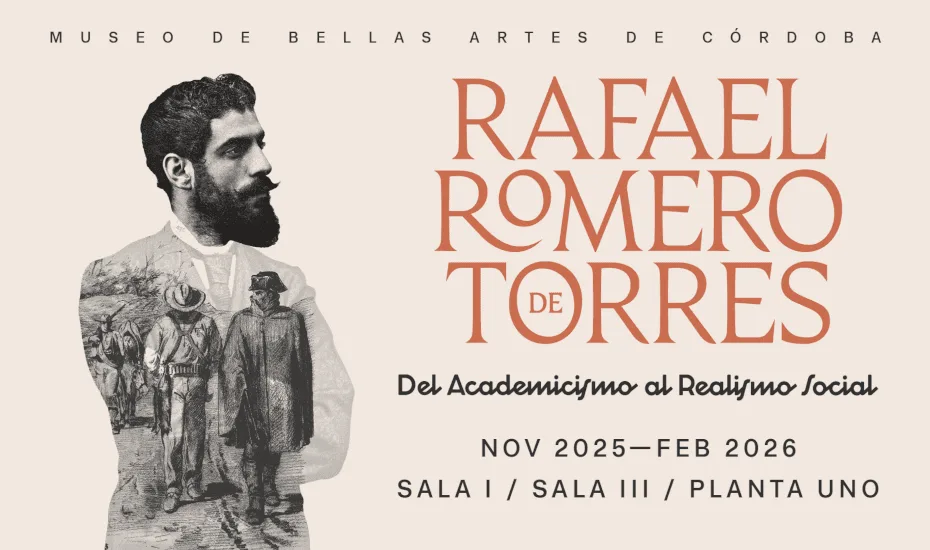
La exposición temporal «Rafael Romero de Torres. Del academicismo al realismo social» ha sido organizada por el Museo de Bellas Artes de Córdoba con motivo del 160 aniversario del nacimiento del artista (figura 1). La muestra, que ha podido ser visitada en las salas I y III del museo cordobés hasta abril de 2026, ha rescatado el legado del hijo mayor de Rafael Romero Barros, una figura fundamental para entender la transición del arte decimonónico hacia el compromiso social en España, pero cuya trayectoria quedó prematuramente truncada y eclipsada por la fama de su hermano Julio Romero de Torres.
Figura 1. Cartel de la exposición «Rafael Romero de Torres. Del academicismo al realismo social». Fuente. Dominio público.
Sala I
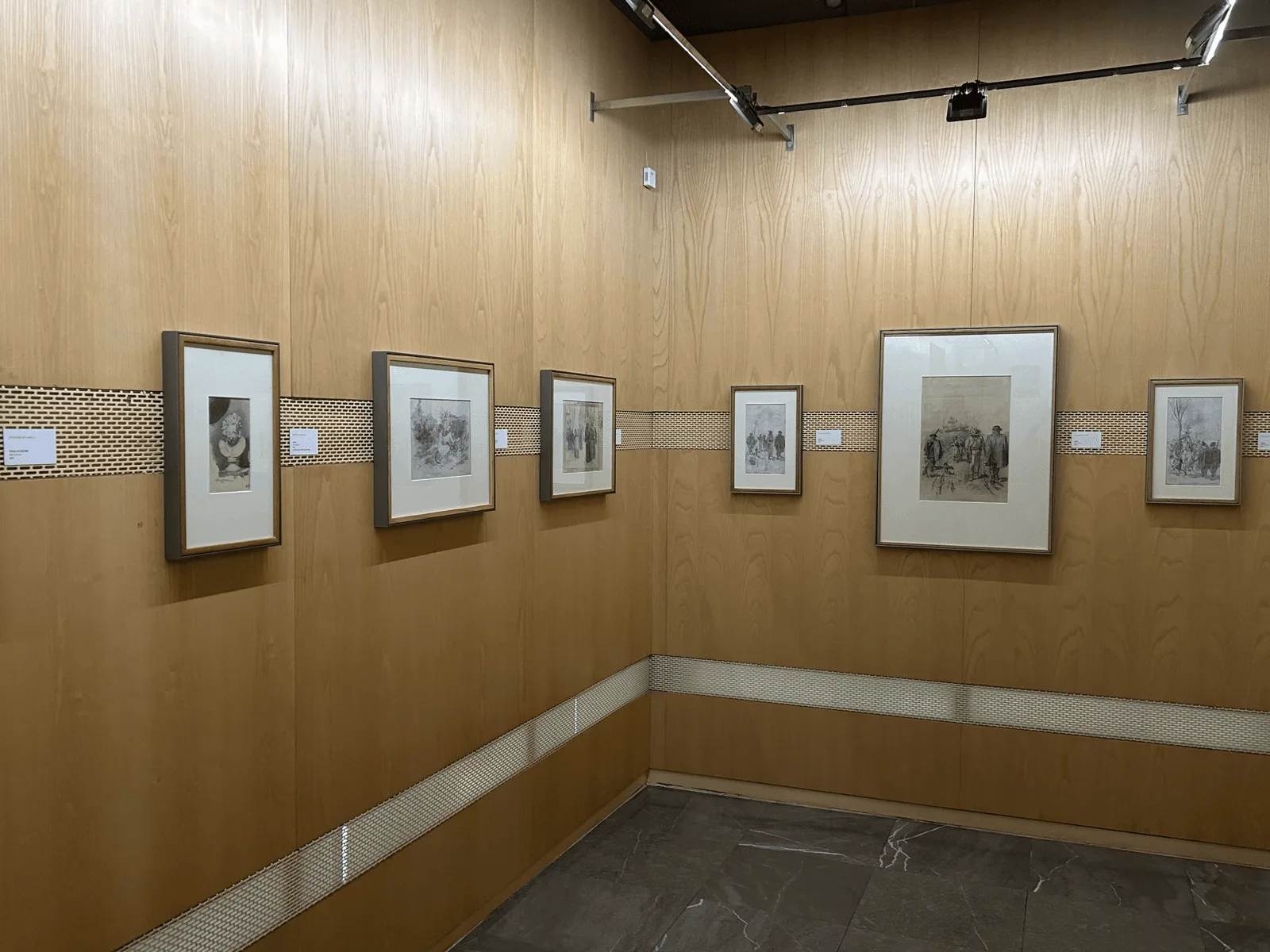
La exposición comienza en la Sala I (figura 2), donde se informa al visitante sobre la posesión de un importante fondo artístico por parte del Museo de Bellas Artes de Córdoba. Estas obras, realizadas sobre papel en diversos formatos y técnicas, constituyen una de las colecciones más significativas de España. Entre ellas se encuentran dibujos y estampas de Rafael Romero de Torres, así como de otros artistas de ámbito local, nacional e internacional. A través de donaciones, compras y depósitos, se han formado dos secciones: una de dibujos, que data desde 1877, y otra de estampas, que abarca desde 1905, comprendiendo obras de los siglos XVIII al XX. El panel informativo concluye con la descripción de los problemas de conservación que afectan a estas piezas.
Figura 2. Sala I de la exposición «Rafael Romero de Torres. Del academicismo al realismo social». Fuente: la autora.
A continuación, el visitante encuentra un nuevo panel con información sobre los dibujos del artista. Estos abarcan diferentes temáticas: elementos arquitectónicos, asuntos históricos, bíblicos, literarios, retratos, temas costumbristas, de críticas sociales y bocetos preparatorios de sus pinturas. La muestra pone un énfasis especial en su etapa formativa en la Real Academia de San Fernando y su posterior estancia en Roma. Se pueden admirar un conjunto de dibujos inspirados en la historia medieval y en obras de Shakespeare (como Romeo y Julieta), que demuestran una sofisticación técnica inusual para su juventud. Además, sus estudios arquitectónicos para el manuscrito Córdoba Monumental y Artística(obra de su padre, Rafael Romero Barros) evidencian un manejo magistral de la plumilla, el grafito y la aguada.
Por otro lado, es preciso mencionar las cartas ilustradas, quizás el elemento más humano de la sala. Estas misivas enviadas a su familia, repletas de tipos humanos y monumentos clásicos capturados con una habilidad técnica asombrosa, le valieron el apodo del «Fortuny cordobés», en referencia al pintor Mariano Fortuny y Marsal.
Finalmente, la exposición destaca su labor como ilustrador en revistas literarias de la época como La Gran Vía o el Almanaque del Diario Córdoba. Este detalle es crucial: Rafael no solo era un artista de museo, sino un comunicador visual que llevó su estética y su mensaje social a las publicaciones de gran alcance del siglo XIX.
Sala III
Una vez pasada la Sala II, la cual conecta las dos estancias de esta exposición, el visitante llega a la Sala III donde encuentra obras sobre papel y óleos sobre lienzo. Este tramo conduce por los años más oscuros y, sin duda, más brillantes a nivel creativo de Rafael Romero de Torres.
Un panel informativo nos pone en contexto sobre las circunstancias vitales del artista, destacando un momento clave: la Exposición Internacional de Bellas Artes de 1892. Rafael concurrió con su obra Buscando patria o Emigrantes a bordo, una pieza que representa el cenit de su realismo comprometido. Sin embargo, pese al reconocimiento del jurado, las intrigas y «grandes influencias» a favor de otros artistas le privaron de la medalla de segundo premio que merecía, relegándolo a un tercer orden. Este desengaño profesional, según las crónicas de la época, minó profundamente su salud y su ánimo.
A ello se sumaría la muerte de su padre (1895), de su hijo Ángel —con poco más de un año de edad— y de su esposa, Remedios Alcalde. Tras estas pérdidas, el artista regresó al hogar familiar, donde falleció de tuberculosis el 29 de julio de 1898, dejando a su hija Julia al cuidado de sus familiares.
A lo largo de las estancias, podemos contemplar dibujos de retratos, desnudos, ilustraciones de cartas, escenas históricas como Colón saliendo de la Mezquita (1892) y escenas de su realismo comprometido, como Los últimos sacramentos o El albañil herido(1890).
En el panel, el visitante puede leer la desgarradora poesía que Ricardo de Montis le dedicó en el primer aniversario de su muerte, y que la exposición reproduce con acierto. En ella se le describe como un «gladiador… que cayó a la postre con mortal herida».
Folletos
Respecto a los folletos de la exposición, el visitante puede adquirir uno en la entrada del museo (figura 3). En él, se ofrece información de la vida y obra de Rafael Romero de Torres, imágenes sobre sus obras y el cartel en grandes dimensiones de la propia exposición. Mediante un sistema de doblaje, el documento va adquiriendo un mayor tamaño, pasando de un A5 a A2.
Figura 3. Folleto de la exposición «Rafael Romero de Torres. Del academicismo al realismo social» abierto en tamaño A3. Fuente: la autora
Conclusión
A modo de conclusión, Rafael Romero de Torres fue un pionero en su campo. Su fallecimiento a los 33 años privó a la historia del arte de una carrera que ya apuntaba hacia el modernismo y que influyó decisivamente en la etapa social de sus hermanos Enrique y Julio.
Esta exposición rescata la trayectoria vital de un artista al que la muerte prematura y la falta de documentos conservados en el archivo familiar lo han desplazado en un segundo plano. El Museo de Bellas Artes de Córdoba logra, con una sensibilidad exquisita, que Rafael Romero de Torres deje de ser «el hermano de» para volver a ser el genio de nobles ideales que buscó, a través de su arte, una patria más justa.
En definitiva, esta muestra es un reflejo del trabajo de recuperación de una figura que supo fusionar el clasicismo romano con la denuncia social, anticipándose a las inquietudes de la Generación del 98. Rescatar su legado artístico permite comprender la evolución del arte español hacia la modernidad.
Bibliografía
Museo de Bellas Artes de Córdoba. (s.f.). Rafael Romero de Torres: Del academicismo al realismo social. Museo de Bellas Artes de Córdoba. Junta de Andalucía. Recuperado de
This translation was generated automatically using qwen2.5:14b-instruct and has not been reviewed by a human editor. It may contain errors, omissions or awkward phrasing — for the authoritative version, please read the original in Spanish. Found a mistake? Let us know at info@arqueotimes.es.
The temporary exhibition «Rafael Romero de Torres. From Academicism to Social Realism» has been organized by the Museum of Fine Arts in Córdoba on the occasion of the 160th anniversary of the artist's birth (figure 1). The show, which could be visited in rooms I and III of the museum until April 2026, has rescued the legacy of the eldest son of Rafael Romero Barros, a key figure for understanding the transition from nineteenth-century art to social commitment in Spain, but whose career was prematurely cut short and overshadowed by his brother Julio Romero de Torres's fame.
Figure 1. Poster for the exhibition «Rafael Romero de Torres. From Academicism to Social Realism». Source. Public domain.
Room I
The exhibition begins in Room I (figure 2), where visitors are informed about the possession of an important art collection by the Museum of Fine Arts of Córdoba. These works, created on paper in various formats and techniques, constitute one of Spain's most significant collections. Among them are drawings and prints by Rafael Romero de Torres as well as other local, national, and international artists. Through donations, purchases, and deposits, two sections have been formed: a section for drawings dating from 1877 and another for prints starting in 1905, encompassing works from the 18th to the 20th centuries. The informational panel concludes with descriptions of conservation issues affecting these pieces.
Figure 2. Room I of the exhibition «Rafael Romero de Torres. From Academicism to Social Realism». Source: the author.
Next, visitors find a new panel with information about the artist's drawings. These cover various themes: architectural elements, historical subjects, biblical scenes, literary topics, portraits, genre scenes, social critiques, and preparatory sketches for his paintings. The exhibition places special emphasis on his formative years at the Royal Academy of San Fernando and his subsequent stay in Rome. A set of drawings inspired by medieval history and works by Shakespeare (such as Romeo and Juliet) demonstrate an unusual technical sophistication for his youth. Additionally, his architectural studies for the manuscript Córdoba Monumental y Artística (by his father, Rafael Romero Barros) showcase a masterful handling of pen-and-ink, graphite, and wash.
On the other hand, it is necessary to mention the illustrated letters, perhaps the most human element in the room. These missives sent to his family, filled with types of people and classical monuments captured with astonishing technical skill, earned him the nickname of «Cordoban Fortuny», a reference to painter Mariano Fortuny y Marsal.
Finally, the exhibition highlights his work as an illustrator for literary magazines such as La Gran Vía or the Almanaque del Diario Córdoba. This detail is crucial: Rafael was not just a museum artist but also a visual communicator who brought his aesthetic and social message to publications of great reach in the 19th century.
Room III
Once past Room II, which connects these two exhibition spaces, visitors arrive at Room III where they find drawing and oil paintings on canvas. This section leads through the artist's darkest years, yet also his most brilliant in terms of creativity.
An informational panel sets the context for the artist’s life, highlighting a crucial moment: the International Exhibition of Fine Arts of 1892. Rafael participated with his work In Search of Homeland or Emigrants Aboard, a piece that represents the pinnacle of his committed realism. However, despite recognition from the jury, intrigues and "great influences" in favor of other artists deprived him of the second prize medal he deserved, relegating him to third place. This professional disappointment, according to contemporary chronicles, deeply affected his health and spirits.
This was compounded by the deaths of his father (1895), his son Ángel —who was less than a year old—, and his wife Remedios Alcalde. After these losses, the artist returned to his family home, where he died of tuberculosis on July 29, 1898, leaving his daughter Julia in the care of relatives.
Throughout the rooms, visitors can view portraits, nudes, illustrated letters, historical scenes such as Colón Leaving the Mosque (1892), and scenes from his committed realism like The Last Sacraments or The Injured Mason (1890).
On the panel, visitors can read the wrenching poetry that Ricardo de Montis dedicated to him on the first anniversary of his death, which the exhibition reproduces with accuracy. He is described as a "gladiator... who fell in the end with mortal wounds."
Flyers
Regarding the exhibition flyers, visitors can purchase one at the museum entrance (figure 3). It offers information about Rafael Romero de Torres's life and work, images of his works, and a large-scale version of the exhibition poster. Through a folding system, the document gradually increases in size from A5 to A2.
Figure 3. Exhibition flyer «Rafael Romero de Torres. From Academicism to Social Realism» opened at A3 size. Source: the author
Conclusion
In conclusion, Rafael Romero de Torres was a pioneer in his field. His premature death at 33 years old deprived art history of a career that pointed towards modernism and which decisively influenced the social phase of his brothers Enrique and Julio.
This exhibition rescues the life story of an artist whose early death and lack of preserved documents in the family archive have relegated him to a secondary role. The Museum of Fine Arts of Córdoba, with exquisite sensitivity, manages to make Rafael Romero de Torres no longer just "the brother of" but once again the genius of noble ideals who sought through his art a more just homeland.
In summary, this show reflects the work of recovering a figure who knew how to fuse Roman classicism with social denunciation, anticipating the concerns of the Generation of '98. Rescuing his artistic legacy allows us to understand the evolution of Spanish art towards modernity.
Bibliography
Museum of Fine Arts of Córdoba. (s.f.). Rafael Romero de Torres: From Academicism to Social Realism. Museum of Fine Arts of Córdoba. Junta de Andalucía. Retrieved from
Rodas Romero, M. D. (2026, 8 de junio). Reseña exposición: Rafael Romero de Torres. Del Academicismo al Realismo Social. Dibujos y pinturas. ArqueoTimes. https://arqueotimes.com/articulos/resena-exposicion-rafael-romero-de-torres-del-academicismo-al-realismo-social-dibujos-y-pinturas/




Comentarios