El episodio de la Adoración de los Magos constituye uno de los temas más persistentes y versátiles del repertorio iconográfico cristiano. Su presencia se rastrea de forma ininterrumpida desde la Antigüedad tardía hasta la contemporaneidad, adaptándose a las sensibilidades teológicas, estéticas y culturales de cada época. Esta durabilidad se explica tanto por su potencia narrativa como por su capacidad para vehicular discursos simbólicos relacionados con la universalidad del cristianismo, la legitimación del poder y la relación entre fe y conocimiento (Mâle, 1922, pp. 56-70).
El único relato canónico que menciona a los magos se encuentra en el Evangelio según San Mateo (2, 1-12). Allí se alude a unos visitantes procedentes de Oriente que, guiados por una estrella, llegan a Jerusalén para adorar al «Rey de los judíos» recién nacido. El texto, sin embargo, es notablemente sobrio: no se especifica su número, ni sus nombres, ni su condición regia, ni su procedencia concreta. Esta ausencia de detalles generó, desde época muy temprana, un vasto proceso de construcción simbólica impulsado por la exégesis patrística, la tradición litúrgica y, de manera fundamental, por las artes visuales (Schiller, 1971, pp. 58-88).
.
A partir de este núcleo narrativo, la cultura cristiana configuró una compleja red de significados que convirtió a los magos en representantes de los pueblos gentiles, en encarnaciones de la sabiduría antigua y, posteriormente, en monarcas que someten los poderes terrenales ante la divinidad. La iconografía resultante no solo refleja la evolución del pensamiento cristiano, sino también los cambios en la percepción europea sobre el mundo, la diversidad étnica y la legitimación de las estructuras políticas (Jensen, 2000, pp. 32-49).
.
1. Los orígenes iconográficos: los magos como sabios orientales
Las representaciones más antiguas del tema se encuentran en el arte paleocristiano de los siglos III y IV, particularmente en las catacumbas romanas de Domitila, Priscila o los santos Pedro y Marcelino. En ellas, los magos aparecen como tres figuras masculinas que avanzan hacia María, sentada con el Niño en su regazo. Aunque Mateo no menciona el número de visitantes, la tradición iconográfica fijó muy pronto el grupo en tres, probablemente por analogía con los dones —oro, incienso y mirra— o por influjo de modelos romanos relacionados con tríadas votivas (Schapiro, 1944, pp. 60-65).
El atuendo de estos primeros magos sigue los códigos visuales empleados por el arte romano para representar a los pueblos orientales: túnicas cortas, pantalones ajustados y gorros frigios. Más que monarcas, se presentan como sabios o astrólogos, en coherencia con la interpretación del episodio como manifestación del reconocimiento del Mesías por parte de los gentiles. La escena remite también a la tradición romana del adoratio, gesto mediante el cual los pueblos sometidos presentaban regalos al emperador, lo que refuerza el carácter simbólico de la imagen.
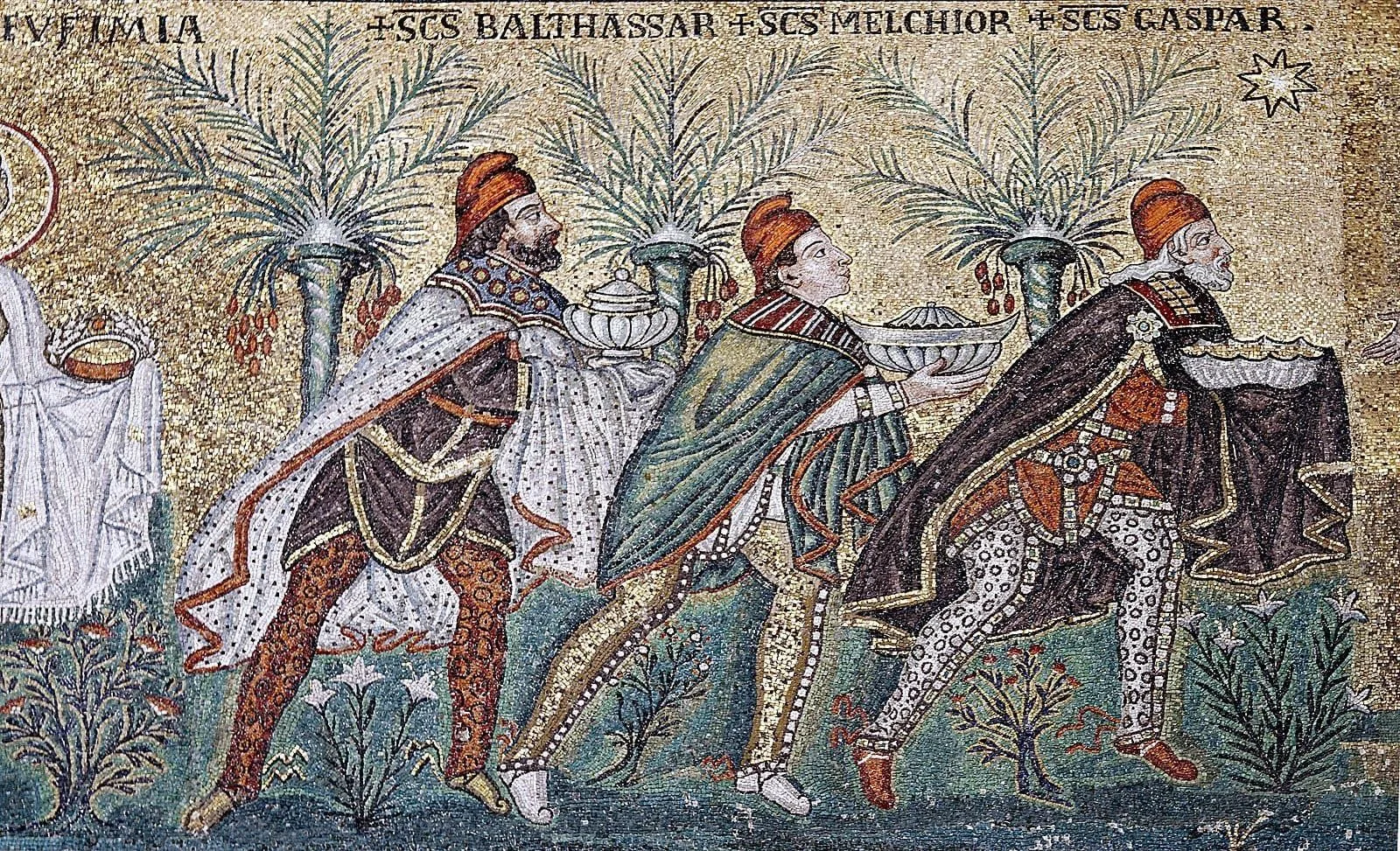
En los mosaicos bizantinos, especialmente en la basílica de Sant’Apollinare Nuovo de Rávena (siglo VI), los magos aparecen en actitud dinámica, casi procesional, portando sus dones con gestos enfáticos. Este conjunto es elemental porque introduce las inscripciones con los nombres de Melchior, Gaspar y Balthasar, que se consolidarán progresivamente en Occidente. Sin embargo, aún carecen de coronas y de los atributos regios que caracterizarán sus representaciones medievales (Demus, 1949, pp. 98-104).
Figura 1. Mosaico de Sant´ Apollinare Nuovo, Rávena. (Siglo VI). Fotografía de José Luiz Bernardes Ribeiro. Creative Commons Attribution-Share Alike 4.0 International. Fuente.
Estas primeras manifestaciones visuales subrayan una idea teológica esencial: los magos encarnan el reconocimiento de Cristo por parte del mundo no judío. En términos iconográficos, constituyen uno de los primeros símbolos de la universalidad del mensaje cristiano.
2. La construcción medieval del modelo regio
A partir del siglo IX, los magos comienzan a transformarse en reyes, un cambio decisivo que responde a factores tanto teológicos como políticos. La liturgia, especialmente la fiesta de la Epifanía, desempeñó un papel central en esta evolución, así como la difusión de textos apócrifos —como el Evangelio Armenio de la Infancia— y las interpretaciones alegóricas de los Padres de la Iglesia. Autores como san Agustín o san León Magno vincularon a los magos con los reinos de la tierra que se someten a Cristo, reforzando su lectura como monarcas.
En manuscritos carolingios y otonianos, así como en capiteles y relieves románicos, los magos ya aparecen coronados y vestidos con atuendos que responden al imaginario de la realeza medieval. Paralelamente, se consolida la idea de que representan las tres edades del hombre —juventud, madurez y vejez— y, desde el siglo XIII, los tres continentes conocidos por la geografía medieval: Europa, Asia y África (Mâle, 1986, pp. 74-82).
Este último elemento introdujo una dimensión racial inédita en la iconografía cristiana. A partir del siglo XIV, y especialmente en el arte gótico del norte de Europa, Baltasar adquiere rasgos africanos. Lejos de ser un simple capricho exótico, este cambio expresa la concepción teológica de la salvación universal y refleja a la vez el creciente contacto de Europa con África subsahariana a través de rutas comerciales y diplomáticas.
Ejemplos notables se encuentran en las puertas de las catedrales de Chartres, Amiens o Estrasburgo, donde la procesión de los reyes se presenta como una marcha triunfal hacia el Niño (Schiller, 1971, pp. 87-102), símbolo máximo del poder divino. En estas obras, la Epifanía funciona como un discurso visual sobre la jerarquía del poder: incluso los monarcas del mundo deben inclinarse ante Cristo.
3. El Renacimiento: lujo, exotismo y humanismo
Durante el Renacimiento, la Adoración de los Magos se convirtió en un escenario privilegiado para la ostentación pictórica. La escena permitía al artista desplegar arquitecturas clásicas, paisajes amplios, animales exóticos y complejas indumentarias, haciendo del tema un escaparate ideal para demostrar virtuosismo técnico y riqueza narrativa.
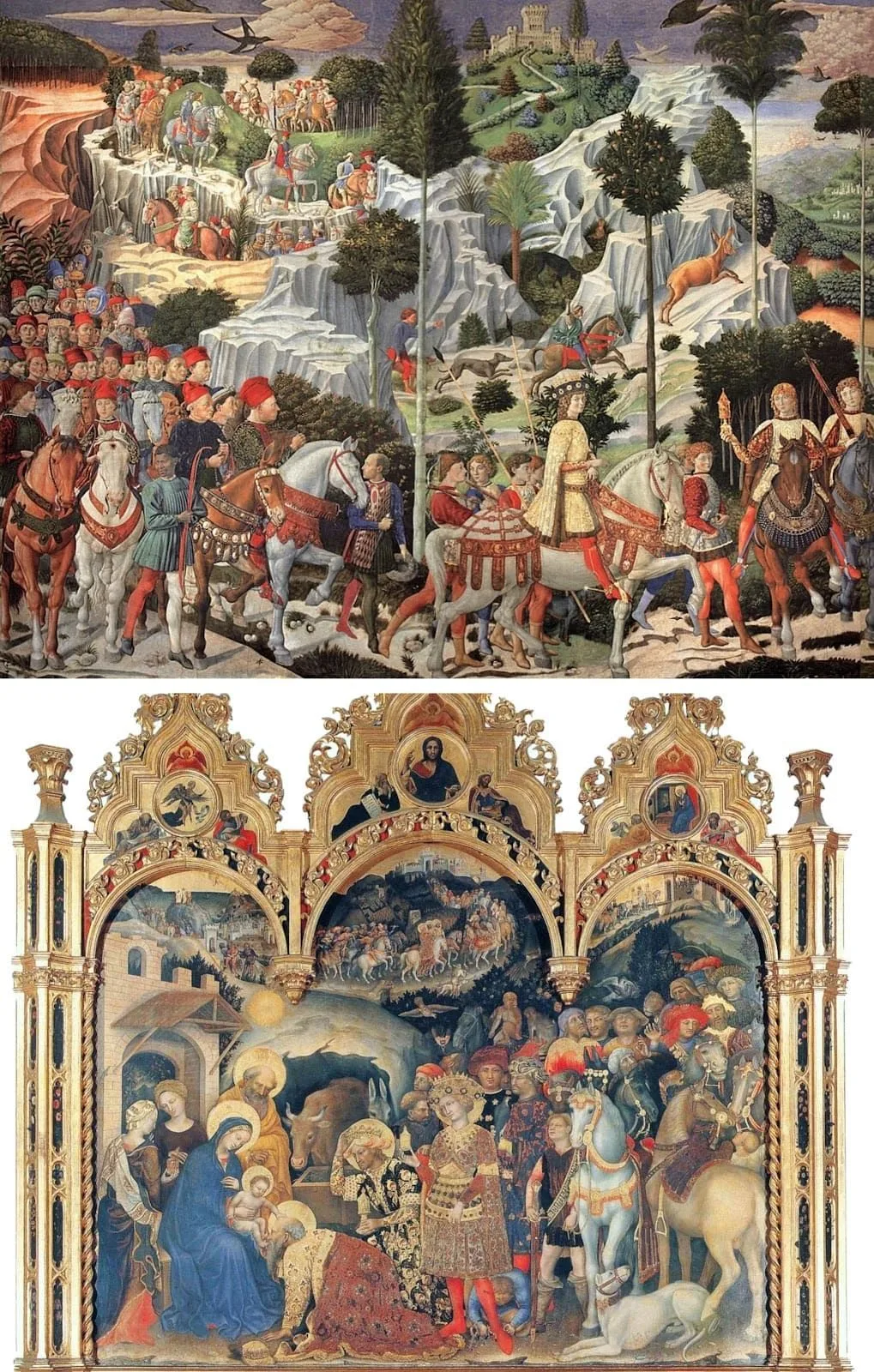
En la Adoración de los Magos de Gentile da Fabriano (1423, Uffizi), la procesión se transforma en un fastuoso desfile cortesano, poblado de detalles preciosistas y referencias a la cultura del lujo del Quattrocento. Por su parte, Benozzo Gozzoli, en la Capilla de los Reyes Magos del Palacio Medici-Riccardi (1459), convierte la escena en una celebración explícita del poder de la familia Médici, cuyos miembros se reconocen en los rostros de los personajes (Strickland, 2003, pp. 58-61).
En el Renacimiento también se acentúa la lectura humanista del episodio: los magos encarnan la síntesis entre astronomía, matemáticas y fe cristiana. La estrella se representa a menudo con precisión científica, como sucede en Giotto, quien la interpreta como un cometa —posiblemente influido por el paso del cometa Halley en 1301— en la capilla Scrovegni (King, 2015, pp. 113-120).
La iconografía renacentista refleja, pues, un equilibrio entre devoción, ciencia, cosmopolitismo y autorrepresentación del poder.
Figura 2. (a) Cortejo de los Reyes Magos, Benozzo Gozzoli, 1459 (Arriba). Dominio Publico. Fuente; (b) Adoración de los Magos, Gentile da Fabriano, 1423 (Abajo). Dominio Público. Fuente.
4. El Barroco: teatralidad y universalidad
En el Barroco, la Adoración de los Magos adquiere una intensa carga emocional y espiritual, en consonancia con los principios de la estética contrarreformista. La teatralidad, la luz dramática y el uso de composiciones dinámicas buscan suscitar devoción mediante la implicación del espectador.
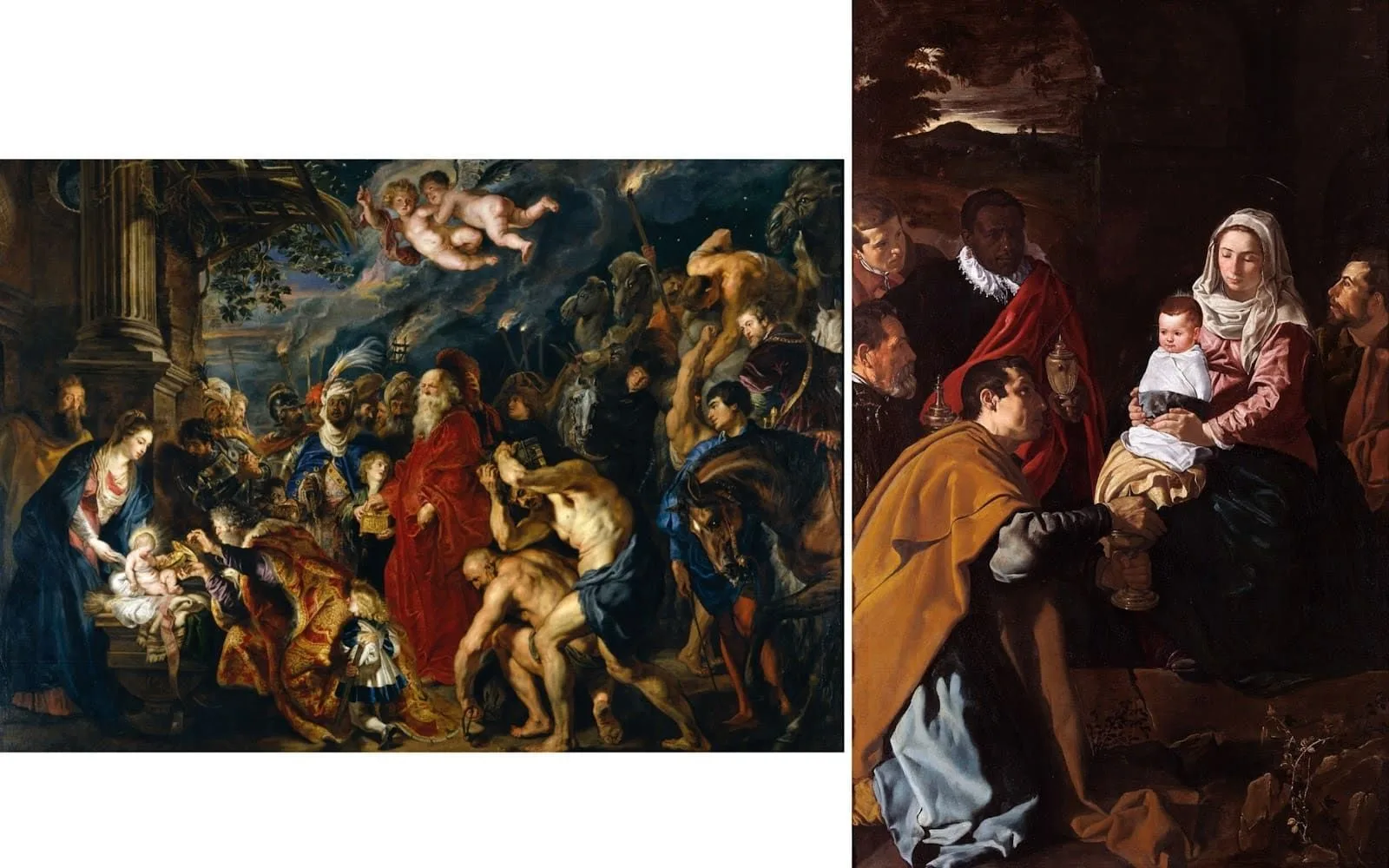
Peter Paul Rubens, en su Adoración de los Magos (1624, Museo del Prado), otorga a la escena un vigor monumental, en la que los personajes parecen participar en un acontecimiento colectivo cargado de energía. La diversidad étnica y cultural se acentúa, reforzando la idea de que todos los pueblos —desde los más cercanos hasta los más remotos— se unen en la adoración al Niño (Vergara, 2004, pp. 120-132).
En España, Velázquez ofrece una interpretación más sobria y realista del mismo pasaje (1619, Museo del Prado). Los magos aparecen con rasgos contemporáneos, lo que aproxima la escena al espectador y refuerza su dimensión humanizadora. Esta versión del tema subraya la sencillez y dignidad del encuentro, frente al esplendor fastuoso de otras interpretaciones europeas (Brown, 1968, pp. 87-90).
En el conjunto del Barroco, la Adoración se convierte en una síntesis visual del mundo cristiano, donde el movimiento, la diversidad de razas, la riqueza cromática y el intercambio de miradas constituyen un mensaje universalista profundamente marcado por la espiritualidad del momento.
Figura 3. (a) Adoración de los Magos, Paul Rubens, 1624 (izquierda). Dominio Público. Fuente; (b) Velázquez, Adoración de los Magos, Diego de Velázquez, 1619 (derecha). Dominio Público. Fuente.
5. Significados simbólicos y lecturas contemporáneas
La simbología asociada a los dones —oro, incienso y mirra— se mantuvo estable a lo largo de los siglos. El oro señala la realeza del Niño, el incienso su naturaleza divina y la mirra anticipa su humanidad y su destino sacrificial. Estos tres elementos consolidaron la lectura teológica de los magos como portadores de un conocimiento que abarca las tres dimensiones de Cristo.
La estrella, por su parte, adquirió una dimensión astronómica progresiva. Desde las interpretaciones literales hasta representaciones con apariencia de cometa o cuerpo celeste, la iconografía refleja debates medievales y renacentistas sobre la naturaleza de los astros, su capacidad de anunciar acontecimientos extraordinarios y el estatus que debía atribuirse a tales señales (Jensen, 2000, pp. 100-103).
En las últimas décadas, instituciones como el Metropolitan Museum of Art (2021) o el Getty Museum (Getty Museum, 2019; Collins & Keene, 2019) han revisado críticamente la figura del rey africano, analizando cómo su representación dialoga con las percepciones europeas de la alteridad y las dinámicas coloniales de la Edad Moderna. En este contexto, la imagen de los magos se ha convertido en un espacio de reflexión sobre la diversidad cultural, la construcción de identidades y el poder visual de la iconografía religiosa.
6. Conclusiones
La evolución iconográfica de los Reyes Magos constituye un testimonio excepcional de la capacidad del arte cristiano para reinterpretar un mismo relato según las necesidades espirituales, políticas y culturales de cada época. Desde los sabios orientales de las catacumbas hasta los reyes universalistas del Barroco, su transformación visual refleja tanto el desarrollo de la teología cristiana como los cambios en el horizonte geográfico, científico y mental de Europa.
La Adoración de los Magos ha funcionado históricamente como un espejo donde la cultura cristiana proyecta sus ideas sobre el poder, la sabiduría, el conocimiento del mundo y la diversidad humana. En última instancia, la imagen de los magos constituye una síntesis visual de la historia del cristianismo: un diálogo constante entre fe y razón, y entre lo terrenal y lo divino.
Bibliografía
Acidini, C. (2007). La Cappella dei Magi. Mandragora, 23-28.
Brilliant, R. (1963). Gesture and Rank in Roman Art. Yale University Press, 80-98.
Brown, J. (1986). Velázquez: Painter and Courtier. Yale University Press, 87–90.
Collins, K., & Keene, B. (2019, 9 mayo). A new exhibition explores Balthazar, a Black African king in medieval and Renaissance European art. Getty Iris. The J. Paul Getty Museum. https://blogs.getty.edu/iris/exhibition-to-examine-balthazar-a-black-african-king-in-medieval-and-renaissance-european-art/
Demus, O. (1949). The Mosaics of Norman Sicily. Routledge.
Getty Museum. (2019). Balthazar: A Black African King in Medieval and Renaissance Art [Exhibition documentation]. The J. Paul Getty Museum.
Jensen, R. M. (2000). Understanding Early Christian Art. Routledge, 32–49; 100–103.
King, D. (2015). The Star of Bethlehem and the Magi. Princeton University Press, 120-113.
Mâle, É. (1922). L’art religieux du XIIIe siècle en France. Armand Colin, 56–70; 93–96.
Mâle, É. (1986). Religious Art in France: The Late Middle Ages. Princeton University Press, 74–82.
Metropolitan Museum of Art. (2020). In Pursuit of the Magi. The Metropolitan Museum of Art.
The Metropolitan Museum of Art. (2021). Exploring representations of the Black Magus in European art. The Metropolitan Museum of Art. https://www.metmuseum.org/perspectives/articles/2021/5/exploring-black-magus-in-european-art
Onians, J. (2007). Art, Culture and Nature in the Italian Renaissance. Yale University Press, 45-69.
Schapiro, M. (1944). The image of the Magi in early medieval art. The Art Bulletin, 26(1), 7–20; 60–65.
Schiller, G. (1971). Iconography of Christian Art (Vol. 1). Lund Humphries, 58–88.
Schiller, G. (1971). The Adoration of the Magi in Renaissance iconography. En Iconography of Christian Art (Vol. 1, 87–102. Lund Humphries.
Strickland, D. (2003). Saracens, Demons and Jews: Making Monsters in Medieval Art. Princeton University Press, 58–61.
Vergara, A. (2004). Rubens: The Adoration of the Magi. Museo Nacional del Prado / Paul Holberton Publishing, 120–132.
.
This translation was generated automatically using qwen2.5:14b-instruct and has not been reviewed by a human editor. It may contain errors, omissions or awkward phrasing — for the authoritative version, please read the original in Spanish. Found a mistake? Let us know at info@arqueotimes.es.
The Adoration of the Magi constitutes one of the most persistent and versatile themes in Christian iconography. Its presence is traced uninterruptedly from Late Antiquity to the present day, adapting to the theological, aesthetic, and cultural sensitivities of each era. This durability is explained both by its narrative power and by its capacity to convey symbolic discourses related to the universality of Christianity, the legitimization of power, and the relationship between faith and knowledge (Mâle, 1922, pp. 56-70).
The only canonical account mentioning the Magi is found in the Gospel according to Saint Matthew (2, 1-12). There it refers to visitors from the East who, guided by a star, arrive in Jerusalem to worship the newborn "King of the Jews." However, the text is notably sparse: it does not specify their number, names, royal status, or specific origin. This lack of detail generated, since very early times, a vast process of symbolic construction driven by patristic exegesis, liturgical tradition, and, fundamentally, by visual arts (Schiller, 1971, pp. 58-88).
.
From this narrative core, Christian culture configured a complex network of meanings that transformed the Magi into representatives of gentile peoples, incarnations of ancient wisdom, and later on, as monarchs who submit earthly powers before divinity. The resulting iconography not only reflects the evolution of Christian thought but also changes in European perceptions about the world, ethnic diversity, and the legitimization of political structures (Jensen, 2000, pp. 32-49).
.
1. Iconographic origins: The Magi as Eastern Sages
The earliest representations of the theme are found in early Christian art from the 3rd and 4th centuries, particularly in Roman catacombs such as Domitila, Priscilla, or Saints Peter and Marcelino. In them, the Magi appear as three male figures advancing towards Mary, seated with the Child on her lap. Although Matthew does not mention the number of visitors, iconographic tradition quickly fixed it at three, probably due to analogy with the gifts—gold, frankincense, and myrrh—or by influence from Roman models related to votive triads (Schapiro, 1944, pp. 60-65).
The attire of these early Magi follows visual codes used by Roman art to represent eastern peoples: short tunics, tight pants, and Phrygian caps. More than monarchs, they are presented as wise men or astrologers, in coherence with the interpretation of the episode as a manifestation of recognition of the Messiah by gentile peoples. The scene also refers to the Roman tradition of adoratio, a gesture through which subjugated peoples offered gifts to the emperor, reinforcing the symbolic character of the image.
In Byzantine mosaics, especially in Sant’Apollinare Nuovo Basilica in Ravenna (6th century), the Magi appear in dynamic poses, almost processional, carrying their gifts with emphatic gestures. This ensemble is fundamental because it introduces inscriptions with the names of Melchior, Gaspar and Balthasar, which would progressively consolidate in the West. However, they still lack crowns and royal attributes that will characterize their medieval representations (Demus, 1949, pp. 98-104).
Figure 1. Mosaic of Sant’Apollinare Nuovo, Ravenna. (6th century). Photograph by José Luiz Bernardes Ribeiro. Creative Commons Attribution-Share Alike 4.0 International. Source.
These early visual manifestations emphasize a key theological idea: the Magi embody the recognition of Christ by non-Jewish peoples. In iconographic terms, they constitute one of the first symbols of the universality of the Christian message.
2. The Medieval Construction of the Royal Model
From the 9th century onwards, the Magi begin to transform into kings, a decisive change that responds to both theological and political factors. Liturgy, especially the Feast of Epiphany, played a central role in this evolution, as well as the spread of apocryphal texts—such as the Armenian Gospel of Infancy—and allegorical interpretations by Church Fathers. Authors like Saint Augustine or Saint Leo the Great linked the Magi with earthly kingdoms that submit to Christ, reinforcing their reading as monarchs.
In Carolingian and Ottonian manuscripts, as well as in Romanesque capitals and reliefs, the Magi already appear crowned and dressed in attire reflecting medieval royal imagery. Simultaneously, the idea solidifies that they represent the three ages of man—youth, maturity, and old age—and, from the 13th century onwards, the three continents known to medieval geography: Europe, Asia, and Africa (Mâle, 1986, pp. 74-82).
This last element introduced a racial dimension unprecedented in Christian iconography. From the 14th century onwards, especially in northern European Gothic art, Balthasar acquires African features. Far from being a mere exotic whim, this change expresses theological conceptions of universal salvation and reflects at the same time the growing contact between Europe and sub-Saharan Africa through trade and diplomatic routes.
Notable examples can be found in the doors of cathedrals in Chartres, Amiens, or Strasbourg, where the procession of kings is presented as a triumphant march towards the Child (Schiller, 1971, pp. 87-102), the ultimate symbol of divine power. In these works, Epiphany functions as a visual discourse on the hierarchy of power: even the monarchs of the world must bow before Christ.
3. The Renaissance: Luxury, Exoticism, and Humanism
During the Renaissance, the Adoration of the Magi became a privileged setting for pictorial ostentation. The scene allowed artists to display classical architectures, expansive landscapes, exotic animals, and complex costumes, making it an ideal showcase to demonstrate technical virtuosity and narrative richness.
In Gentile da Fabriano's Adoration of the Magi (1423, Uffizi), the procession transforms into a sumptuous courtly parade, populated with precious details and references to the culture of luxury in the Quattrocento. Meanwhile, Benozzo Gozzoli's Chapel of the Magi at Palazzo Medici-Riccardi (1459) turns the scene into an explicit celebration of the power of the Medici family, whose members are recognizable in the faces of the characters (Strickland, 2003, pp. 58-61).
In the Renaissance, the humanistic reading of the episode also intensified: the Magi embody the synthesis between astronomy, mathematics, and Christian faith. The star is often depicted with scientific precision, as in Giotto's interpretation as a comet—possibly influenced by Halley’s Comet in 1301—in the Scrovegni Chapel (King, 2015, pp. 113-120).
Thus, Renaissance iconography reflects a balance between devotion, science, cosmopolitanism, and self-representation of power.
Figure 2. (a) Procession of the Magi, Benozzo Gozzoli, 1459 (Top). Public Domain. Source; (b) Adoration of the Magi, Gentile da Fabriano, 1423 (Bottom). Public Domain. Source.
4. The Baroque: Theater and Universality
In the Baroque period, the Adoration of the Magi acquires an intense emotional and spiritual charge, in line with the principles of Counter-Reformation aesthetics. Theatricality, dramatic lighting, and dynamic compositions aim to evoke devotion through viewer engagement.
Peter Paul Rubens, in his Adoration of the Magi (1624, Museo del Prado), endows the scene with monumental vigor, where characters seem to participate in a collective event brimming with energy. Ethnic and cultural diversity are accentuated, reinforcing the idea that all peoples—from those nearest to the most remote—unite in adoration of the Child (Vergara, 2004, pp. 120-132).
In Spain, Velázquez offers a more sober and realistic interpretation of the same passage (1619, Museo del Prado). The Magi appear with contemporary features, bringing the scene closer to the viewer and emphasizing its humanizing dimension. This version of the theme underscores the simplicity and dignity of the encounter against the splendid splendor of other European interpretations (Brown, 1968, pp. 87-90).
In the Baroque as a whole, the Adoration becomes a visual synthesis of the Christian world, where movement, racial diversity, chromatic richness, and exchanges of glances constitute a universal message deeply marked by the spirituality of the time.
Figure 3. (a) Adoration of the Magi, Paul Rubens, 1624 (left). Public Domain. Source; (b) Velázquez, Adoration of the Magi, Diego de Velázquez, 1619 (right). Public Domain. Source.
5. Symbolic Meanings and Contemporary Readings
The symbolism associated with the gifts—gold, frankincense, and myrrh—remained stable over the centuries. Gold signifies the royalty of the Child, frankincense his divine nature, and myrrh anticipates his humanity and sacrificial destiny. These three elements consolidated the theological reading of the Magi as bearers of knowledge encompassing the three dimensions of Christ.
The star, on the other hand, acquired a progressively astronomical dimension. From literal interpretations to representations resembling comets or celestial bodies, iconography reflects medieval and Renaissance debates about the nature of stars, their capacity to announce extraordinary events, and the status that should be attributed to such signs (Jensen, 2000, pp. 100-103).
In recent decades, institutions like the Metropolitan Museum of Art (2021) or the Getty Museum (Getty Museum, 2019; Collins & Keene, 2019) have critically revisited the figure of the African king, analyzing how its representation engages with European perceptions of alterity and colonial dynamics in the Modern Age. In this context, the image of the Magi has become a space for reflection on cultural diversity, identity construction, and the visual power of religious iconography.
6. Conclusions
The evolution of the iconographic representation of the Three Kings constitutes an exceptional testimony to the capacity of Christian art to reinterpret a single narrative according to the spritual, political, and cultural needs of each era. From eastern sages in the catacombs to universal monarchs in Baroque art, their visual transformation reflects both the development of Christian theology and changes in Europe's geographical, scientific, and mental horizons.
The Adoration of the Magi has historically functioned as a mirror where Christian culture projects its ideas about power, wisdom, knowledge of the world, and human diversity. Ultimately, the image of the Magi constitutes a visual synthesis of the history of Christianity: an ongoing dialogue between faith and reason, and between earthly and divine realms.
Bibliography
Acidini, C. (2007). The Chapel of the Magi. Mandragora, 23-28.
Brilliant, R. (1963). Gesture and Rank in Roman Art. Yale University Press, 80-98.
Brown, J. (1986). Velázquez: Painter and Courtier. Yale University Press, 87–90.
Collins, K., & Keene, B. (2019, May 9). A new exhibition explores Balthazar, a Black African king in medieval and Renaissance European art. Getty Iris. The J. Paul Getty Museum. https://blogs.getty.edu/iris/exhibition-to-examine-balthazar-a-black-african-king-in-medieval-and-renaissance-european-art/
Demus, O. (1949). The Mosaics of Norman Sicily. Routledge.
Getty Museum. (2019). Balthazar: A Black African King in Medieval and Renaissance Art [Exhibition documentation]. The J. Paul Getty Museum.
Jensen, R. M. (2000). Understanding Early Christian Art. Routledge, 32–49; 100–103.
King, D. (2015). The Star of Bethlehem and the Magi. Princeton University Press, 120-113.
Mâle, É. (1922). L’art religieux du XIIIe siècle en France. Armand Colin, 56–70; 93–96.
Mâle, É. (1986). Religious Art in France: The Late Middle Ages. Princeton University Press, 74–82.
Metropolitan Museum of Art. (2020). In Pursuit of the Magi. The Metropolitan Museum of Art.
The Metropolitan Museum of Art. (2021). Exploring representations of the Black Magus in European art. The Metropolitan Museum of Art. https://www.metmuseum.org/perspectives/articles/2021/5/exploring-black-magus-in-european-art
Onians, J. (2007). Art, Culture and Nature in the Italian Renaissance. Yale University Press, 45-69.
Schapiro, M. (1944). The image of the Magi in early medieval art. The Art Bulletin, 26(1), 7–20; 60–65.
Schiller, G. (1971). Iconography of Christian Art (Vol. 1). Lund Humphries, 58–88.
Schiller, G. (1971). The Adoration of the Magi in Renaissance iconography. In Iconography of Christian Art (Vol. 1, 87–102. Lund Humphries.
Strickland, D. (2003). Saracens, Demons and Jews: Making Monsters in Medieval Art. Princeton University Press, 58–61.
Vergara, A. (2004). Rubens: The Adoration of the Magi. Museo Nacional del Prado / Paul Holberton Publishing, 120–132.
Cózar Arias, M. (2025, 26 de diciembre). Sabiduría, poder y diversidad: Construcción visual de los Reyes Magos. ArqueoTimes. https://arqueotimes.com/articulos/sabiduria-poder-y-diversidad-construccion-visual-de-los-reyes-magos/




#/media/Archivo:Gentile_da_Fabriano_001.jpg)
#/media/Archivo:La_adoraci%C3%B3n_de_los_Reyes_Magos_(Rubens,_Prado).jpg)
#/media/Archivo:Vel%C3%A1zquez_-_Adoraci%C3%B3n_de_los_Reyes_(Museo_del_Prado,_1619).jpg)
Comentarios