En la segunda parte de esta serie de artículos dejamos pendiente analizar el porqué de la falta de coherencia poliorcética y cronológica de algunas de estas torres. Dedicaremos pues, esta última entrega a analizar, profundizando en el final de las Guerras de Bandos, el componente simbólico de estas torres.
Para entender mejor el cambio de paradigma que sufrieron estas torres, repasaremos el contexto del fin de la guerra de bandos. En palabras de Fernández de Larrea, de la misma forma en la que la disolución del poder público provocó el feudalismo —siendo consecuencia de ello las guerras de bandos—, la lenta y larga restauración de dicho poder durante la Baja Edad Media trajo el fin de este conflicto (2009: 85). En este proceso, los poderes municipales, ya oligarquizados por los más poderosos mercaderes, superaron al poder señorial y a las aspiraciones del campesinado, valiéndose del apoyo real para reformar los concejos, limitando así el acceso al poder a los estratos más favorecidos (Díaz de Durana, 2002: 25-26). Las villas, con intención de hacer frente a los desordenes causados por estas luchas y reforzar su poder, crearon las Hermandades a principios del siglo XV, las cuales fueron constituidas y reforzadas por Enrique IV en 1463. Las élites urbanas buscaban con ello, además de su primacía, la normalidad de las actividades artesanas y comerciales por medio del refuerzo de la justicia villana (Díaz de Durana, 1999: 164-166).
Tras jurar los Fueros del Señorío de Vizcaya, el rey Fernando el Católico recibe la pleitesía de las Juntas Generales, reunidas en Guernica junto al Árbol, el 30 de julio de 1476. Pintura de Francisco de Mendieta y Retes, 1609. Fuente: Sindarin, Wikimedia Commons.
Dacosta, huyendo de la simplista explicación que sólo enfrenta a las villas y los parientes mayores, argumentando que el efecto de la mencionada reacción antiseñorial fue limitado y, que los viejos linajes mantuvieron su poder, aduce como una de las causas del fin de las guerras de bandos fue un cambio generacional, pues coincide en época con la muerte de muchos de los más fieros parientes mayores. También menciona la iniciativa pacificadora propia que tomaron muchos de ellos por medio de estrategias matrimoniales, e incluso la habilidad gubernamentativa de los reyes, que colocaron a los viejos linajes a cargo de las políticas expansivas de los reinos (2003: 372-377). Esta pacificación, como se puede ver, trajo una redistribución del poder, dejando por tanto en manos de la burguesía las riendas de las villas y sus concejos, mientras los viejos linajes banderizos redirigieron su mirada a la corte y la órbita militar, en la cual encabezarían guerras y exploraciones de ultramar. No obstante, el mencionado autor también advierte de que en cada territorio la situación variaba, y si bien en Bizkaia el proceso fue de esa forma, en Gipuzkoa la Hermandad tuvo un mayor protagonismo y además se dio una fusión más marcada entre la burguesía villana y los parientes mayores (2003: 380).
El componente simbólico de las casas torre
Según Yrizar, a partir del siglo XV, sobre todo después del desmoche de torres decretado en 1457, se empezó a apreciar la antigüedad de las torres: las que se libraron del derribo se conservaron, adaptándolas como bien sabemos a tiempos más pacíficos para poder albergar mejores condiciones de habitabilidad, pero conservando ciertas características castrenses para certificar la antigüedad y el poder del linaje. En el caso de las torres destruidas, se reutilizaron los viejos sillares en la construcción de los nuevos palacios para darles un aspecto vetusto (1946: 304). El texto de Yrizar, analiza la historia y arquitectura de la torre de los Legazpi. Lo llamativo en este caso es que dicho linaje, según el autor, no tuvo ni arte ni parte en las Guerras de Bandos, pues desde un principio tuvo una faceta más política que bélica (1946: 301). Lo que da a entender este hecho es que la estética de la casa torre era importante en cuanto a lo que a representación de status se refiere, aunque nunca se llegasen a usar, o más tarde, no tuvieran una funcionalidad militar o el linaje fuera carente de antigüedad o prestigio.
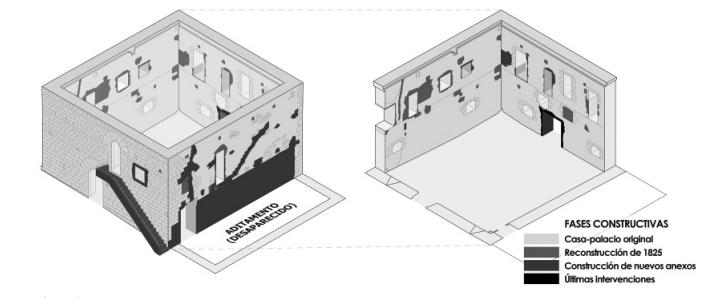
Fases constructivas de la Casa de Fagoaga (Luengas, 2017: 928).
Un ejemplo que respalda esta hipótesis sería la tendencia seguida por las torres construidas en el siglo XV. El mejor ejemplo de una de estas «falsas» torres podría ser la torre de los Fagoaga. Este linaje no participó activamente en las Guerras de Bandos, pero a mediados del siglo XV, gracias a su enriquecimiento por medio de la producción de hierro —eran propietarios de muchas ferrerías de la zona— tuvieron una gran influencia sobre los habitantes de Oiartzun (Luengas, 2017: 925). Lo más probable es que el edificio fuera mandado hacer por Juan de Fagoaga a finales del siglo XV a cuenta de los ingresos conseguidos por las ferrerías, para mostrar su superioridad en la jerarquía social. La fachada tiene una jerarquización clara, y el alzado frontal se distingue por su uso de piedra sillar muy labrada, más típica de los palacios de los siglos XV-XVI que de las casas torre. Otras características similares se aprecian en la calidad de los arcos escarzanos del interior del acceso y en la tipología de las cañoneras, pues tienen un sentido más estético que práctico; otro detalle más evidente es la existencia de una puerta de entrada directa a la planta baja, lo cual nos transmite que esta torre nunca tuvo un auténtico carácter militar (Luengas, 2017: 929).
El palacio Fagoaga es un buen ejemplo de la transición entre la casa torre y el palacio tras el fin de las Guerras de Bandos, usando unas soluciones más complejas y más cómodas que las típicas usadas en las casas torres (Luengas, 2017: 933). En la misma medida, se utilizan similitudes con las viejas torres para aristocratizar su aspecto y ensalzar la fama y prestigio del linaje, cosa entendible en el contexto de la familia Fagoaga.
Según Azkarate y García, la construcción de una casa torre generaba un gran movimiento y uso de recursos, aunque fueran por lo general fortificaciones humildes construidas con materiales locales: grandes vigas de madera, ingentes cantidades de piedra, muchos trabajadores a sueldo, el conocimiento y la organización de los trabajos de construcción… esto daba pie a los linajes a demostrar su riqueza y su poder por medio de la construcción de estos edificios; quizás, en casos en los que tales riquezas y poderes no fueran tan grandes, se acudía a la ayuda de linajes compañeros de bando, lo cual también da una idea de la estrecha colaboración y relación entre linajes (2004: 23). En resumen, la casa torre era un exponente material del poder del pariente mayor, pero también simbolizaba la relación del linaje con el territorio, su antigüedad y su prestigio.
Conclusiones
Para entender el valor histórico y patrimonial de estas casas torre, es imprescindible entender su interacción con el medio, tal y como describe la teoría del Sistema Arquitectónico Banderizo de Azkarate y García, pues explica la relación de los linajes con la sociedad y los bienes del feudo, explicando con gran acierto el poder que esto les confería. Teniendo en cuenta el papel militar de la torre y añadiéndole además el componente de organización de la producción local y la importancia material y visual de la propia estructura, se puede explicar el papel simbólico que adquirió para los parientes mayores: si bien la pacificación de la Baja Edad Media arrebató su función militar, les dotó de un prestigio del que se tuvieron que valer los señores feudales en su integración en la esfera de la corte, o para justificar su nobleza ante la generalización de la hidalguía universal en el caso de los linajes más humildes. La materia de estudio es muy interesante e interdisciplinar, lo cual, a pesar de entorpecer hasta ahora el desarrollo de las líneas de investigación por muchas décadas, ha terminado por enriquecer el resultado final de las investigaciones; no obstante, la propia historiografía y los agujeros documentales nos muestran que aún queda mucho por saber acerca de estas estructuras.
Bibliografía:
Azkarate Garai Olaun, A. & García Gómez, I. (2004). “Las casas-torre bajomedievales. Análisis sistémico de un proceso de reestructuración espacial/territorial”. Arqueología de la Arquitectura 3, 7-37. Recuperado de: https://arqarqt.revistas.csic.es/index.php/arqarqt/article/view/59/56
Díaz de Durana Ortiz de Urbina, J. R. (1999). Luchas sociales y luchas de bandos en el País Vasco durante la Baja Edad Media. Historiar: revista trimestral de historia 3, 154-171. Recuperado de: https://addi.ehu.es/handle/10810/22005
Fernández de Larrea Rojas, J.A. (2009). Las guerras privadas: el ejemplo de los bandos oñacino y gamboino en el País Vasco. Clío & Crímen: Revista del Centro de Historia del Crimen de Durango 6, 85-109. Recuperado de: https://drive.google.com/file/d/12dpEfqxkE_IFlE9IDs_GZNaGVrLtIr6X/view
Luengas Carreño, D. (2017). La casa-palacio de Fagoagoa, en Oiartzun (Gipuzkoa): análisis del sistema constructivo y elementos arquitectónicos originales de una Residencia Señorial Bajomedieval. Actas Vol. 2.indb, Madrid, Sociedad Española de Historia de la Construcción, 925-934. Recuperado de: http://www.sedhc.es/biblioteca/actas/Luengas-Carre__o_.pdf
This translation was generated automatically using qwen2.5:14b-instruct and has not been reviewed by a human editor. It may contain errors, omissions or awkward phrasing — for the authoritative version, please read the original in Spanish. Found a mistake? Let us know at info@arqueotimes.es.
In the second part of this series of articles, we left pending an analysis of why some of these towers lack chronological and poliorcetic coherence. We will therefore dedicate this final installment to analyzing, delving into the end of the Wars of Parties, the symbolic component of these towers.
To better understand the paradigm shift that these towers underwent, we will review the context of the end of the war of parties. In the words of Fernández de Larrea, just as the dissolution of public power led to feudalism—being a consequence thereof the wars of parties—the slow and long restoration of said power during the Late Middle Ages brought an end to this conflict (2009: 85). During this process, the municipal powers, already oligarchized by the most powerful merchants, surpassed the lordly power and the aspirations of the peasantry, relying on royal support to reform the councils, thereby limiting access to power for the more favored strata (Díaz de Durana, 2002: 25-26). The towns, with the intention of countering the disorder caused by these struggles and reinforcing their own power, created the Hermandades at the beginning of the 15th century, which were constituted and reinforced by Henry IV in 1463. The urban elites sought through this not only their primacy but also the normalization of artisanal and commercial activities via the reinforcement of town justice (Díaz de Durana, 1999: 164-166).
After swearing the Fueros of the Señorío de Vizcaya, King Ferdinand the Catholic receives homage from the General Juntas, gathered in Guernica under the Tree on July 30, 1476. Painting by Francisco de Mendieta y Retes, 1609. Source: Sindarin, Wikimedia Commons.
Dacosta, avoiding the simplistic explanation that only pits towns against the greater relatives, arguing that the effect of the aforementioned anti-lord reaction was limited and that old lineages maintained their power, cites a generational change as one cause for the end of the wars of parties. This coincides with the death of many of the fiercest greater relatives. He also mentions an initiative to pacify themselves, which many took through marital strategies, and even the governmental skill of the kings who placed old lineages in charge of the expansion policies of their kingdoms (2003: 372-377). This pacification led to a redistribution of power, leaving thus the reins of towns and councils in the hands of the bourgeoisie while old banderizo lineages redirected their gaze towards court and military orbit, leading wars and overseas explorations. Nonetheless, this author also warns that each territory had its own variation; whereas in Bizkaia the process was as described, in Gipuzkoa the Hermandad played a greater role and there was a more marked fusion between town bourgeoisie and greater relatives (2003: 380).
The symbolic component of tower houses
According to Yrizar, from the 15th century onwards, especially after the demolition order of towers in 1457, the antiquity of the towers began to be appreciated: those that were spared destruction were conserved and adapted as we know them for more peaceful times to provide better living conditions, but retaining certain military characteristics to certify the lineage's antiquity and power. In the case of destroyed towers, old stones were reused in the construction of new palaces to give them an ancient appearance (1946: 304). Yrizar’s text analyzes the history and architecture of the tower of the Legazpi family. What is striking here is that according to the author, this lineage had neither part nor say in the Wars of Parties, as it had from the start a more political than military facet (1946: 301). This fact suggests that the aesthetics of the tower house were important regarding status representation, even if they were never used or later did not have a functional military purpose or lacked lineage antiquity and prestige.
Construction phases of the Fagoaga House (Luengas, 2017: 928).
An example supporting this hypothesis would be the trend followed by towers built in the 15th century. The best example of one of these "false" towers could be the Fagoaga tower. This lineage did not actively participate in the Wars of Parties, but mid-15th century, thanks to their enrichment through iron production—being owners of many forges in the area—they had great influence over Oiartzun's inhabitants (Luengas, 2017: 925). It is most likely that the building was commissioned by Juan de Fagoaga at the end of the 15th century using the earnings from the forges to show their superiority in social hierarchy. The facade has a clear hierarchy and the front elevation stands out due to its use of finely worked ashlar stone, more typical of palaces from the 15th-16th centuries than tower houses. Other similar characteristics are seen in the quality of the scissor arches inside the entrance and in the type of embrasures, as they have a more aesthetic rather than practical purpose; another evident detail is the existence of a direct entry door to the ground floor, which conveys that this tower never had an authentic military character (Luengas, 2017: 929).
Construction phases of the Fagoaga House (Luengas, 2017: 928).
The Fagoaga palace is a good example of the transition from tower house to palace after the end of the Wars of Parties, using more complex and comfortable solutions than those typically used in tower houses (Luengas, 2017: 933). In the same measure, similarities with old towers are utilized to aristocratize its appearance and enhance the fame and prestige of the lineage, which is understandable given the context of the Fagoaga family.
According to Azkarate and García, the construction of a tower house generated significant movement and use of resources, though they were generally modest fortifications built with local materials: large wooden beams, vast quantities of stone, many paid workers, the knowledge and organization of building works... This gave lineages an opportunity to demonstrate their wealth and power through the construction of these buildings; perhaps in cases where such wealth and power were not so great, help from allied banderizo lineages was sought, which also gives an idea of the close collaboration and relationship between lineages (2004: 23). In summary, the tower house was a material manifestation of the greater relative's power but also symbolized the lineage’s relation to the territory, its antiquity, and prestige.
Conclusions
To understand the historical and patrimonial value of these tower houses, it is essential to understand their interaction with the environment as described by Azkarate and García's Banderizo Architectural System theory, which explains the relationship between lineages and society and feudal assets, accurately explaining the power this conferred upon them. Considering the military role of the tower and adding its component of local production organization and the material and visual importance of the structure itself, one can explain the symbolic role it acquired for greater relatives: while the pacification of the Late Middle Ages stripped away their military function, it endowed them with a prestige they had to leverage in their integration into the court sphere or to justify their nobility against the generalization of universal hidalguía in the case of more humble lineages. The subject matter is very interesting and interdisciplinary, which despite hindering research development for many decades has enriched the final results; nonetheless, historiography and documentary gaps show that there is still much to learn about these structures.
Díaz de Durana Ortiz de Urbina, J. R. (1999). Social struggles and banderizo wars in the Basque Country during the Late Middle Ages. Historiar: revista trimestral de historia 3, 154-171. Retrieved from: https://addi.ehu.es/handle/10810/22005
Fernández de Larrea Rojas, J.A. (2009). The private wars: the example of Oñacino and Gamboino bands in the Basque Country. Clío & Crímen: Revista del Centro de Historia del Crimen de Durango 6, 85-109. Retrieved from: https://drive.google.com/file/d/12dpEfqxkE_IFlE9IDs_GZNaGVrLtIr6X/view
Luengas Carreño, D. (2017). The Fagoaga palace-house in Oiartzun (Gipuzkoa): analysis of the construction system and original architectural elements of a Medieval Seigniorial Residence. Actas Vol. 2.indb, Madrid, Sociedad Española de Historia de la Construcción, 925-934. Retrieved from: http://www.sedhc.es/biblioteca/actas/Luengas-Carre__o_.pdf
Alfonso Martin Dorronsoro, V., & Cipitria Herrero, I. (2023, 30 de enero). Casas torre feudales del País Vasco: reflejo del status de los parientes mayores (parte III y final).. ArqueoTimes. https://arqueotimes.com/articulos/casas-torre-feudales-del-pais-vasco-reflejo-del-status-de-los-parientes-mayores-parte-iii-y-final/





Comentarios