Figura 1. Vaso policromado de Tikal, tumba 196. Archivo Kerr (K8008).
Las aves que pueblan la región conocida como el área maya fueron objeto de numerosas representaciones pictóricas a lo largo del desarrollo de esta cultura, ocupando un lugar importante dentro de ellas como divinidades (García Barrios, 2009: 93). La variabilidad de especies diferentes dotó al imaginario maya de un rico contenido pictórico con manifestaciones artísticas de todo tipo. Esto se debe principalmente al entorno en donde se desarrollaron, a esa riqueza y variedad de flora y fauna.
La cualidad sagrada que presentan las aves se debe a su capacidad de volar y desplazarse por la bóveda celeste (de La Garza, 1995: 7). Las aves en sí son animales errenales pero tienen la capacidad de volar por el cielo, en donde se encuentran principalmente las divinidades mesoamericanas (de La Garza, 1995: 7). Para los mayas, las aves más importantes son el quetzal, el azulejo real, la guacamaya roja, el águila, la urraca y el colibrí, principalmente (de La Garza, 1998: 129). Estas aves forman parte de varios aspectos de la vida de las sociedades mayas como la religión, los rituales y el juego de pelota, en donde la vestimenta empleada hace alusión a esos signos del mundo celestial (Barrrois y Tokovinine, 2005: 27).
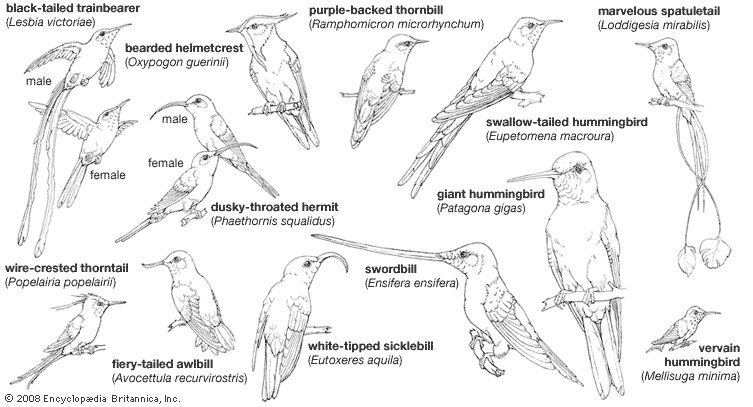
Figura 2. Colibrí de la región de costa, Calypte costae, de la amilia de los Trochilidae.Figura 3. Algunas especies de colibrí en Mesoamérica. Consultado en britannica.com.Figura 4. Tamaño máximo y mínimo que puede tener un colibrí, entre 5 y 22cm. Tomado de West y Butler (2010:17).
En concreto, el colibrí es un ave relacionada con el carácter y la potencia sexual del Sol, simbolizando la sexualidad (de La Garza, 1998: 129; Caja, 2012: 10). Del mismo modo, este pequeño pájaro se suele asociar con la guerra y con la sangre, como ocurre en Chichén Itzá, en donde sus representaciones están asociadas con el sacrificio humano (de La Garza, 1998: 129; Caja, 2010: 10). Esto se debe a una de las principales características de esta ave, la forma en la que extraen el néctar de las flores introduciendo su alargado pico en ellas, comparándolo con el derramamiento de sangre (Caja. 2010: 10; Miller y Taube, 1993: 98). En algunas representaciones del posclásico reciente en Chichén Itzá se muestra al colibrí en un contexto de sacrificio humano atravesando con su pico el corazón de una persona que emerge de una flor (Miller y Taube, 1993: 98).
Figura 5. Algunas especies de colibríes.
El colibrí, conocido como tzunuun o dzunnuun por los mayas, y uitzitzilin en algunas regiones de México, es una de las aves más pequeñas y frágiles de mesoamérica, siendo también una de las aves más veloces y ágiles que existen (Caja 2010: 9; Seller 1996: 230; de La Garza, 1995: 58). Existen diferentes variedades y tipos de colibríes en toda la región mesoamericana, con colores y tamaños diversos. Por un lado, los que presentan un plumaje oscuro y con verdes metálicos que adornan espalda y cola, denominados quetzaluitzilin; y por otro lado, los tonos más cobrizos y rojos, con aspecto brillante que cubren varias partes del cuerpo (Seller, 1996: 230). A pesar de su pequeño tamaño son aves muy agresivas que les lleva a enfrentarse a otras especies de mayor tamaño, de ahí su relación con la guerra y la sangre (Miller y Taube, 1993: 98).
Figura 6. Vaso pintado de Tikal, fechado para el período Clásico Tardío, muestra un colibrí con alas de serpiente. Tomado de Taube (1987: 3).
Existe en la región mesoamericana, de forma general, un mito relacionado con el componente sexual de esta ave. El mito retrata la historia de un héroe que se transforma para intentar seducir a una mujer (Chinchilla Mazariegos, 2010: 58). Todas las variables del mito culminan en un mismo punto, la creación del Sol y la Luna (Chinchilla Mazariegos, 2010: 58).
En la actualidad, esta concepción se sigue manteniendo en algunos lugares de Mesoamérica. Según ciertos estudios de etno-ornitología se han mostrado varias formas rituales en las que son empleados animales sagrados, en este caso, el colibrí es usado en brebajes amorosos para fomentar el deseo en la mujer amada y atraerla.
Figura 7. Escena de un colibrí o mosquito chupando del pecho de una mujer. Tomado de Chinchilla (2010: 46).
Conclusiones
Los estudios relacionados con el significado de los animales en la iconografía maya son amplios, sin embargo, los relacionados exclusivamente con esta ave son escasos y breves, con referencias repetitivas. Por lo tanto, es complejo determinar la profundidad de su significado. En otras culturas como la azteca, el colibrí juega un papel más protagonista y la bibliografía relacionada con esta ave es mucho más amplia. El paisaje y entorno en donde se desarrollan estas culturas influye notablemente en el desarrollo de un imaginario concreto, plagado de los animales e insectos que habitan ese entorno. Al mismo tiempo, siguen existiendo sociedades mayas contemporáneas que ayudan a comprender el simbolismo de esta ave, teniendo en cuenta que los conceptos y creencias evolucionan con el tiempo pasando de ser un ave sexual, de sangre y guerra, a un animal empleado para curar dolencias, enfermedades y despertar el deseo sexual.
Bibliografía
Barrois, R. R. y Tokovinine, A. (2005). El inframundo y el mundo celestial en el juego de pelota maya. J. P. Laporte, B. Arroyo y H. Mejía (Eds.). XVIII Simposio de Investigaciones Arqueológicas en Guatemala, (2004), 27-38. Museo Nacional de Arqueología y Etnología, Guatemala.
Caja, A. (2010). Las aves de los mayas prehispánicos. Asociación FLAAR Mesoamérica.
Chinchilla Mazariegos, O. (2010). Of birds and insects: the hummingbird myth in ancient Mesoamérica”. Ancient Mesoamerica, 21, pp. 45-61.
De La Garza, M. (1995). Aves sagradas de los mayas. Facultad de Filosofía y Letras y Centro de Estudios Mayas del Instituto de Investigaciones Filológicas de la UNAM, México.
De La Garza, M. (1998). Rostros de lo sagrado en el mundo maya. Paidós, México.
García Barrios, A. (2009). Chaahk y el Pájaro O’ en el periodo Clásico y en narraciones coloniales. Estudios de Cultura Maya, 34 (1), 91-114.
Miller, M. y Taube, K. (1993). The Gods and Symbols of Ancient Mexico and the Maya. An Illustrated Dictionary of Mesoamerican Religion. Thames y Hudson, Londres.
Seller, E. (1996). The Animal Pictures of the Mexican and Maya Manuscript. Collected Works in Mesoamerican Linguistics and Archaeology, 5. Labyrunthos, California.
Taube, K. (1987). A Representetion of the Principal Bird Deity in the Paris Codex. Research Reports on ancient Maya Writing, 6. Center for Maya Research. www.mesoweb.com
West, G. C. y Butler, C. A. (2010). Do Hummingbirds Hum? Fascinating answers to questions about hummingbirds. Rutgers University Press, New Brunswick, New Jersey y Londres.
This translation was generated automatically using qwen2.5:14b-instruct and has not been reviewed by a human editor. It may contain errors, omissions or awkward phrasing — for the authoritative version, please read the original in Spanish. Found a mistake? Let us know at info@arqueotimes.es.
Birds that inhabit the region known as the Maya area were the subject of numerous pictorial representations throughout the development of this culture, occupying an important place within them as deities (García Barrios, 2009: 93). The variability of different species endowed the Mayan imagination with a rich pictorial content with artistic manifestations of all kinds. This is mainly due to the environment in which they developed, characterized by its richness and variety of flora and fauna.
The sacred quality that birds present stems from their ability to fly and move through the celestial vault (de La Garza, 1995: 7). Birds themselves are earthly animals but have the capacity to fly in the sky, where Mesoamerican deities mainly reside (de La Garza, 1995: 7). For the Maya, the most important birds are the quetzal, the royal turaco, the scarlet macaw, the eagle, the raven, and the hummingbird, primarily (de La Garza, 1998: 129). These birds form part of various aspects of Mayan society such as religion, rituals, and ball games, where clothing alludes to signs from the celestial world (Barrois and Tokovinine, 2005: 27).
Figure 2. Hummingbird of the coastal region, Calypte costae, from the Trochilidae family.Figure 3. Some species of hummingbirds in Mesoamerica. Retrieved from britannica.com.Figure 4. Maximum and minimum size a hummingbird can have, between 5 and 22cm. Taken from West and Butler (2010:17).
Specifically, the hummingbird is an animal associated with the character and sexual potency of the Sun, symbolizing sexuality (de La Garza, 1998: 129; Caja, 2012: 10). Similarly, this small bird is often associated with war and blood, as seen in Chichén Itzá, where its representations are linked to human sacrifice (de La Garza, 1998: 129; Caja, 2010: 10). This is due to one of the main characteristics of this bird, how it extracts nectar from flowers by inserting its long beak into them, comparing it with the spilling of blood (Caja. 2010: 10; Miller and Taube, 1993: 98). In some representations of the late Postclassic period in Chichén Itzá, the hummingbird is shown in a context of human sacrifice piercing through the heart of a person emerging from a flower (Miller and Taube, 1993: 98).
Figure 5. Some species of hummingbirds.
The hummingbird, known as tzunuun or dzunnuun by the Maya and uitzitzilin in some regions of Mexico, is one of the smallest and most fragile birds in Mesoamerica, also being among the fastest and most agile (Caja 2010: 9; Seller 1996: 230; de La Garza, 1995: 58). There are different varieties and types of hummingbirds throughout the Mesoamerican region, with various colors and sizes. On one hand, those that present a dark plumage with metallic green accents on their back and tail, called quetzaluitzilin; and on the other hand, tones more coppery and red, with a shiny appearance covering several parts of the body (Seller, 1996: 230). Despite its small size, they are very aggressive birds that lead them to confront larger species, hence their association with war and blood (Miller and Taube, 1993: 98).
Figure 6. Painted Vase from Tikal, dated to the Late Classic period, shows a hummingbird with wings of serpents. Taken from Taube (1987: 3).
There exists in Mesoamerica, generally speaking, a myth related to the sexual component of this bird. The myth depicts the story of a hero who transforms himself to try and seduce a woman (Chinchilla Mazariegos, 2010: 58). All variables of the myth culminate at one point, the creation of the Sun and Moon (Chinchilla Mazariegos, 2010: 58).
In contemporary times, this conception is still maintained in some places of Mesoamerica. According to certain studies of ethno-ornithology, several ritual forms have been shown where sacred animals are used; in this case, the hummingbird is used in love potions to foster desire in a loved woman and attract her.
Figure 7. Scene of a hummingbird or mosquito sucking from the breast of a woman. Taken from Chinchilla (2010: 46).
Conclusions
Studies related to the meaning of animals in Maya iconography are extensive, however, those specifically related to this bird are scarce and brief, with repetitive references. Therefore, it is complex to determine the depth of its significance. In other cultures such as Aztec, the hummingbird plays a more prominent role and the literature related to this bird is much broader. The landscape and environment in which these cultures develop significantly influence the creation of a specific imagery filled with animals and insects that inhabit that environment. At the same time, contemporary Maya societies still exist, helping to understand the symbolism of this bird, taking into account that concepts and beliefs evolve over time from being an animal of sex, blood, and war to one used for healing ailments, diseases, and awakening sexual desire.
Bibliography
Barrois, R. R. and Tokovinine, A. (2005). The Underworld and the Celestial World in Maya Ballgame. J. P. Laporte, B. Arroyo and H. Mejía (Eds.). XVIII Simposio de Investigaciones Arqueológicas en Guatemala, (2004), 27-38. Museo Nacional de Arqueología y Etnología, Guatemala.
Caja, A. (2010). Birds of the Prehispanic Maya. FLAAR Mesoamérica Association.
Chinchilla Mazariegos, O. (2010). Of birds and insects: the hummingbird myth in ancient Mesoamerica”. Ancient Mesoamerica, 21, pp. 45-61.
De La Garza, M. (1995). Sacred Birds of the Maya. Faculty of Philosophy and Letters and Center for Mayan Studies of the Institute of Philosophical Investigations of UNAM, Mexico.
De La Garza, M. (1998). Faces of the Sacred in the Maya World. Paidós, Mexico.
García Barrios, A. (2009). Chaahk and the Bird O’ in the Classic Period and Colonial Narratives. Estudios de Cultura Maya, 34 (1), 91-114.
Miller, M. and Taube, K. (1993). The Gods and Symbols of Ancient Mexico and the Maya. An Illustrated Dictionary of Mesoamerican Religion. Thames & Hudson, London.
Seller, E. (1996). The Animal Pictures of the Mexican and Maya Manuscript. Collected Works in Mesoamerican Linguistics and Archaeology, 5. Labyrinthos, California.
Taube, K. (1987). A Representation of the Principal Bird Deity in the Paris Codex. Research Reports on Ancient Maya Writing, 6. Center for Maya Research. www.mesoweb.com
West, G. C. and Butler, C. A. (2010). Do Hummingbirds Hum? Fascinating answers to questions about hummingbirds. Rutgers University Press, New Brunswick, New Jersey & London.
Sheila Fernandez, M. (2022, 1 de agosto). La pequeña flecha verde. El simbolismo sexual maya del colibrí. ArqueoTimes. https://arqueotimes.com/articulos/la-pequena-flecha-verde-el-simbolismo-sexual-maya-del-colibri/





Comentarios