¿Es la Edad Media una etapa oscura? ¿Cuál es el origen de esta idea sobre el medievo? ¿Por qué prevalece aún hoy en nuestro imaginario colectivo? En palabras de Eduardo Baura García, la Edad Media es… «la época que más prejuicios, simplificaciones y generalizaciones ha merecido» (Baura, 2012, p. 15). Para Sandra Sáenz-López Pérez: «Pensar en la Edad Media supone aún hoy llenarla de ignorancia, misoginia, intolerancia…» (Sáenz, 2020, p. 70).
A lo largo de los siglos han surgido en torno a la Edad Media múltiples miradas e interpretaciones que han ido conformando esta etapa de la historia desde distintas posturas históricas, culturales, filosóficas, políticas y económicas. Ningún momento de nuestra historia está libre de juicios e interpretaciones, así como de una sesgada visión del pasado desde el presente. El análisis de la historia también está sujeto a los distintos agentes que sobre ella actúan, articulando o desarticulando el discurso histórico según se adapte a la tendencia imperante del momento. Es por ello que, a lo largo de una serie de artículos, se pretende abordar cómo se ha construido y cómo ha evolucionado el concepto de Edad Media, atendiendo a distintas etapas históricas: Renacimiento, Ilustración, sigloXIX, sigloXX y sigloXXI.
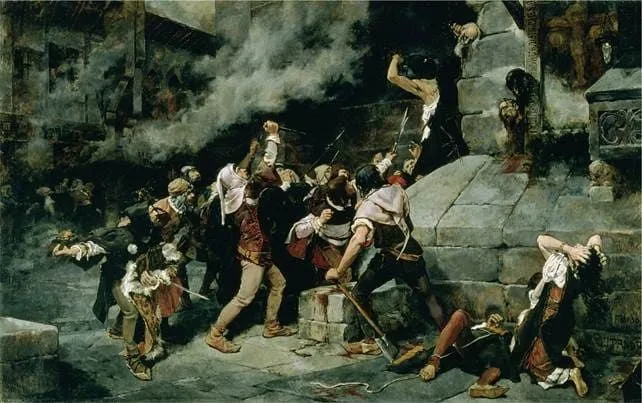
Figura 1. A los pies del Salvador, Masacre de los Judios en la Edad Media. Vicente Cutanda Toraya (1887). Dominio Público. Fuente.
La Edad Media se ha proyectado en la cultura popular como una época de estancamiento social y científico, también en lo moral, entendiendo que existe un distanciamiento con la Antigüedad clásica y sus valores. En este sentido, resulta interesante atender a otros conceptos como Tardorromanidad, Tardoantigüedad o Antigüedad tardía, los cuales también encierran una problemática en cuanto a su comprensión, adscripción cronológica y contenido propio en relación con el inicio del medievo; esta terminología se comprendecomo el periodode transición entre la antigüedad y la Edad Media (Santana, 2018, pp. 197-200).
Ni en el medievo occidental ni en los territorios orientales del Imperio romano (conocido como Imperio bizantino), ni en el mundo persa e islámico, existió un abandono de las ideas y presupuestos del mundo clásico. La Edad Media, al igual que en otras épocas de la historia, tuvo lugar un gran desarrollo de lo material, lo intelectual y lo simbólico (Sáenz, 2020, p. 70). Esto es algo más que superado en el mundo académico, como así lo demuestran un gran número de publicaciones e investigaciones llevadas a cabo a lo largo de décadas, proceso que tuvo su auge sobre todo a partir de la segunda mitad del siglo XX y que continúa en la actualidad (Baura, 2012, p.14). Sin embargo, aún hoy la Edad Media se relaciona comúnmente con el desorden, el hambre, la peste, la pobreza y los abusos de la nobleza sobre el campesinado (González, 2006, pp. 117–118).
La problemática inicial a la que nos enfrentamos al abordar esta cuestión es que nos encontramos ante un periodo histórico realmente extenso, de diez siglos, cuyos márgenes cronológicos aceptados comúnmente irían desde la caída del Imperio romanode Occidente en el 476 d. C. hasta el descubrimiento de América en 1492 (Sáenz, 2020, p. 70) o la caída de Constantinopla en 1453 (Murillo, 2014: 528; González, 2006, p. 125).
Figura 2. «Clérigo, caballero y obrero representando las tres clases[6] », ilustración de la escuela francesa de Li Livres dou Santé (finales del siglo XIII). Dominio público. Fuente.
Otros acontecimientos que tienen lugar en el siglo XV, como la paz tras la guerra de los Cien Años, la invención de la imprenta, la definitiva conformación de los Estados nación europeos, la escisión del cristianismo e incluso el propio esplendor renacentista, pueden entenderse como elementos que influyeron en el final de la Edad Media y el comienzo de la Edad Moderna. Del mismo modo, nos encontramos con una época compleja, con gran cantidad de protagonistas, acontecimientos y un amplio espacio territorial (Villalba y Novoa, 2015, p. 13).
La construcción de la Edad Media en el humanismo renacentista
Es durante el Renacimiento, a finales del siglo XV, en el seno de la sociedad italiana, cuando comienza a gestarse una mirada a la Antigüedad clásica, entendiéndola, desde la cosmovisión del momento, como un tiempo glorioso. El hombre moderno comprenderá, desde los presupuestos de Petrarca —considerado padre del humanismo— que la Edad Media fue una suerte de «espacio intermedio» de oscuridad y desazón, alejado de la perfección clásica (Villalba y Novoa, 2015, p. 17).
En su poema África (1338), Petrarca dejó constancia de un deseo para unos tiempos que anhelaba y que habrían de significar una nueva Edad de Oro: «Disipadas las tinieblas, nuestros nietos caminarán de nuevo en la pura claridad del pasado». (Villalba y Novoa, 2015, p. 18).
Es entendida entonces la Edad Media, ya desde su origen, de una forma despectiva. La propia concepción del término, interpretándose como una etapa que se sitúa entre la Edad Antigua y la Edad Moderna (Baura, 2012, p. 11). Es esta visión la que se impondrá en la Europa occidental durante los siglos XV, XVI y XVII, considerando que existe una asimilación entre el mundo antiguo y el nuevo, siendo el objetivo del segundo emular al primero (Villalba y Novoa, 2015, p. 18). Este esquema tripartito de una época media y oscura entre dos épocas culturalmente más reseñables tiene sus orígenes en el Renacimiento (Baura, 2012, p. 11), siendo vista la Edad Media como una época «bárbara» frente al esplendor cultural que supuso el mundo clásico y grecorromano (Murillo, 2014, pp. 527-528). Desde esta posición, se evidencia que la Edad Media es entendida como un enorme «paréntesis» de casi mil años (Villalba y Novoa, 2015, p. 18).
Había nacido la tenebrosa Edad Media. Con ello, se había producido una profunda y radical ruptura histórica…constituyó una creación ideológica de gran relevancia, no en vano, pese a su inexistente adecuación a la realidad, la vigencia de esta concepción ideológica habría de prolongarse durante siglos, hasta alcanzar los tiempos actuales (Baura, 2012, p. 22).
El historiador y humanista Flavio Biondo (1388-1463) propuso acotar este periodo entre el siglo V, con la caída del Imperio Romano de Occidente, y el siglo XV, pero sin dotarlo de nombre. Por el contrario, Giovanni Andrea dei Busi (1417-1475), obispo de Alesia, pocos años después, lo bautizaría como Media Tempestas. En 1469, en una carta del obispo puede leerse en un párrafo: «sed mediae tempestatis tum veteris, tum recentiores usque ad nostra tempora» (Valdeón, 2003, p. 311). La expresión Media Tempestas haría referencia a este tiempo intermedio entre la Antigüedad y el humanismo renacentista (Valdeón, 2003, p. 311). Posteriormente veremos cómo historiadores y filólogos usarán términos como Media Aetas o Media Tempora, imponiéndose finalmente el término Medium Aevum.
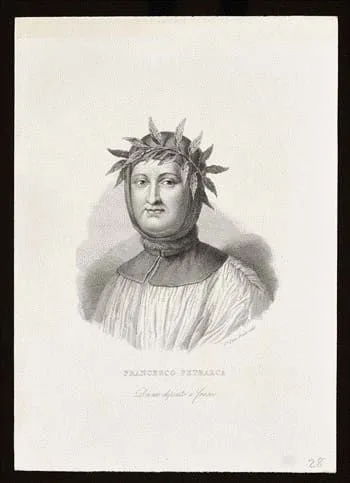
Figura 3. Francesco Petrarca. Caterina Piotti Pirola (1837). Dominio Público. Fuente.
Esta concepción de la Edad Media está sujeta también a una cuestión filológica, pues se entendía que se había adulterado y abandonado la lengua latina, rasgo inequívoco de la tradición clásica y romana (Valdeón, 2003, p. 312). La realidad es que no hubo una ruptura en la Edad Media con la tradición clásica, sino que esta se mantuvo y pervivió, marcando en gran parte la cosmovisión medieval, siendo el tránsito entre la Antigüedad y la Edad Media una etapa más de desarrollo histórico (Tomàs, 2017, p. 27).
Conclusiones
Como hemos observado a través de este análisis, la idea sobre una Edad Media oscura, aún hoy día prevaleciente en parte en nuestro imaginario colectivo, tiene su origen en el seno del pensamiento humanista durante el Renacimiento italiano. Desde esta perspectiva se entendería la Edad Media como un tiempo intermedio entre la Antigüedad clásica y el Renacimiento, calificando esos «Tiempos Medios» como una etapa sumida en las tinieblas. Una Media Tempestadque hoy día sabemos que no la caracterizó.
Bibliografía
Baura, E. (2012). El origen del concepto historiográfico de la Edad Media oscura. La labor de Petrarca, Estudios Medievales Hispánicos, 1, 7-22
Fernández, D. (2018). El mito del paraíso andalusí. Musulmanes, cristianos y judíos bajo el dominio islámico en la España medieval. Almuzara.
González, C. (2006). La construcción de la Edad Media: Mito y realidad, Publicaciones de la Institución Tello Téllez de Meneses, 77, 117-135
Murillo, J. I. (2014). Rémi BRAGUE, Mitos de la Edad Media. La filosofía en el cristianismo, el judaísmo y el islam medievales, Granada: Nuevo Inicio, 2013, 342 pp. Scripta Theologica, 46, 505-508.
Sáenz-López, S. (2020). Desmontando mitos sobre la Tierra en la Edad Media. Cuadernos del CEMyR, 28,69-96
Santana, R. (2018). El concepto de Tardoantigüedad. Revisión historiográfica y problemas metodológicos. En Cutillas, E. (coord.) Convergencia y transversalidad en humanidades: actas de las VII Jornadas de Investigación de la Facultad de Filosofía y Letras de la Universidad de Alicante, 197-202.
Tomàs, B. (2017). Interpretación del mito en la Edad Media. El Mirador. Revista de alumnos de la Facultad de Filosofía. Universidad Pontificia de Salamanca, 17, 27-45
Valdeón, J. (2003). La valoración histórica de la Edad Media entre el mito y la realidad. En De la Iglesia, J. I. y Martín, J. L. (coord.) Memoria, mito y realidad en la historia medieval: XIII Semana de Estudios Medievales, Nájera, del 29 de julio al 2 de agosto de 2002, 311-329
Villalba, F. J. y Novoa, F. (2015). Para comprender la Edad Media. Editorial Universidad de Sevilla.
This translation was generated automatically using qwen2.5:14b-instruct and has not been reviewed by a human editor. It may contain errors, omissions or awkward phrasing — for the authoritative version, please read the original in Spanish. Found a mistake? Let us know at info@arqueotimes.es.
An approach to the study of the Middle Ages
Is the Middle Ages a dark period? What is the origin of this idea about the medieval era? Why does it still prevail in our collective imagination today? In Eduardo Baura García's words, the Middle Ages are... «the era that has earned the most prejudices, simplifications, and generalizations» (Baura, 2012, p. 15). For Sandra Sáenz-López Pérez: «Thinking about the Middle Ages still entails filling it with ignorance, misogyny, intolerance...» (Sáenz, 2020, p. 70).
Throughout the centuries, multiple perspectives and interpretations have emerged around the Middle Ages, shaping this period of history from various historical, cultural, philosophical, political, and economic standpoints. No moment in our history is free from judgments and interpretations, nor from a bias-ridden view of the past from the present. The analysis of history is also subject to different agents acting upon it, articulating or disarticulating the historical discourse according to its adaptation to the prevailing trend at any given moment. It is for this reason that, over a series of articles, we aim to address how the concept of Middle Ages has been constructed and evolved, attending to different historical stages: Renaissance, Enlightenment, 19th century, 20th century, and 21st century.
Figure 1. At the feet of the Savior, Massacre of Jews in the Middle Ages. Vicente Cutanda Toraya (1887). Public Domain. Source.
The Middle Ages have been projected in popular culture as an era of social and scientific stagnation, also morally, understanding that there is a distance with the Classical Antiquity and its values. In this sense, it is interesting to attend to other concepts such as Late Roman Age, Late Antiquity, or Late Ancient Period, which also enclose a problematic in terms of their understanding, chronological attribution, and own content in relation to the beginning of the medieval period; this terminology is understood as the transition period between antiquity and the Middle Ages (Santana, 2018, pp. 197-200).
Neither in Western Medieval, nor in the eastern territories of the Roman Empire (known as Byzantine Empire), nor in the Persian and Islamic worlds did there exist an abandonment of the ideas and presuppositions of the classical world. The Middle Ages, like other periods of history, saw a great development of material, intellectual, and symbolic aspects (Sáenz, 2020, p. 70). This is something that has been overcome in academic circles as demonstrated by numerous publications and research carried out over decades, with an upsurge particularly from the mid-20th century onwards and continuing to this day (Baura, 2012, p. 14). However, even today the Middle Ages are commonly associated with disorder, hunger, plague, poverty, and the abuses of nobility over peasants (González, 2006, pp. 117–118).
The initial problem we face when addressing this issue is that we are dealing with a historical period truly extensive, spanning ten centuries, whose chronological margins commonly accepted range from the fall of the Western Roman Empire in 476 AD to the discovery of America in 1492 (Sáenz, 2020, p. 70) or the fall of Constantinople in 1453 (Murillo, 2014: 528; González, 2006, p. 125).
Figure 2. «Cleric, knight and worker representing the three classes[6] », illustration from the French school of Li Livres dou Santé (late 13th century). Public domain. Source.
Other events that take place in the 15th century, such as peace after the Hundred Years' War, the invention of the printing press, the definitive formation of European nation-states, the schism of Christianity and even the Renaissance itself, can be understood as elements influencing the end of the Middle Ages and the beginning of the Modern Age. Similarly, we find ourselves in a complex era, with many protagonists, events, and an extensive territorial space (Villalba y Novoa, 2015, p. 13).
The construction of the Middle Ages in Renaissance humanism
It is during the Renaissance, at the end of the 15th century, within Italian society, when a view towards Classical Antiquity begins to take shape, understanding it, from the worldview of the time, as a glorious period. The modern man would understand, based on Petrarch's presuppositions —considered the father of humanism— that the Middle Ages was a sort of «intermediate space» of darkness and despondency, far from classical perfection (Villalba y Novoa, 2015, p. 17).
In his poem Africa (1338), Petrarch left a record of a desire for times that he yearned for and which would signify a new Golden Age: «Dispersed the shadows, our grandchildren will walk again in the pure clarity of the past». (Villalba y Novoa, 2015, p. 18).
The Middle Ages is then understood, from its very origin, in a derogatory manner. The conception of the term itself, interpreting it as an era situated between Antiquity and Modern Age (Baura, 2012, p. 11). This vision would impose itself in Western Europe during the 15th, 16th, and 17th centuries, considering that there is an assimilation between the ancient world and the new one, with the goal of the latter emulating the former (Villalba y Novoa, 2015, p. 18). This tripartite schema of a dark era between two culturally more notable periods has its origins in the Renaissance (Baura, 2012, p. 11), with the Middle Ages being seen as an «uncivilized» period compared to the cultural splendor of the classical and Greco-Roman world (Murillo, 2014, pp. 527-528). From this position, it is evident that the Middle Ages are understood as a vast «parenthesis» of nearly a thousand years (Villalba y Novoa, 2015, p. 18).
The Dark Ages had been born. With this, a profound and radical historical break had occurred...it was an ideological creation of great significance; not without reason, despite its inapplicability to reality, the ideological conception would persist for centuries, reaching our times (Baura, 2012, p. 22).
The historian and humanist Flavio Biondo (1388-1463) proposed limiting this period to the fifth century, with the fall of the Western Roman Empire, but without giving it a name. On the contrary, Giovanni Andrea dei Busi (1417-1475), bishop of Alesia, a few years later, would baptize it as Media Tempestas. In 1469, in a letter from the bishop, one can read: «sed mediae tempestatis tum veteris, tum recentiores usque ad nostra tempora» (Valdeón, 2003, p. 311). The expression Media Tempestas referred to this intermediate time between Antiquity and the Renaissance humanism (Valdeón, 2003, p. 311). Subsequently, we will see how historians and philologists would use terms such as Media Aetas or Media Tempora, with the term Medium Aevum eventually prevailing.
Figure 3. Francesco Petrarca. Caterina Piotti Pirola (1837). Public Domain. Source.
This conception of the Middle Ages is also subject to a philological question, as it was understood that Latin had been adulterated and abandoned, an unmistakable feature of classical tradition and Roman heritage (Valdeón, 2003, p. 312). The reality is that there was no break in the Middle Ages with classical tradition; rather, this continued and persisted, marking much of medieval worldview, making the transition between Antiquity and the Middle Ages another stage of historical development (Tomàs, 2017, p. 27).
Conclusions
As we have observed through this analysis, the idea of a dark Middle Ages, still prevalent in part in our collective imagination today, has its origins within Renaissance humanist thought. From this perspective, the Middle Ages would be understood as an intermediate period between Classical Antiquity and the Renaissance, characterizing these "Middle Times" as an era submerged in darkness. A Media Tempestas, which we now know did not characterize it.
Bibliography
Baura, E. (2012). The origin of the historiographical concept of dark Middle Ages. Petrarch's work, Estudios Medievales Hispánicos, 1, 7-22.
Fernández, D. (2018). The myth of the Andalusian paradise. Muslims, Christians and Jews under Islamic rule in medieval Spain. Almuzara.
González, C. (2006). The construction of the Middle Ages: Myth and reality, Publicaciones de la Institución Tello Téllez de Meneses, 77, 117-135.
Murillo, J. I. (2014). Rémi BRAGUE, Myths of the Middle Ages. Philosophy in medieval Christianity, Judaism and Islam, Granada: Nuevo Inicio, 2013, 342 pp. Scripta Theologica, 46, 505-508.
Sáenz-López, S. (2020). Debunking myths about the Earth in the Middle Ages. Cuadernos del CEMyR, 28, 69-96.
Santana, R. (2018). The concept of Late Antiquity: A historiographical review and methodological problems. In Cutillas, E. (coord.) Convergence and transversality in humanities: Proceedings of the VII Research Days of the Faculty of Philosophy and Letters at the University of Alicante, 197-202.
Tomàs, B. (2017). Interpretation of myth in the Middle Ages. The Watchtower. Journal of students from the Faculty of Philosophy. Universidad Pontificia de Salamanca, 17, 27-45.
Valdeón, J. (2003). Historical valuation of the Middle Ages between myth and reality. In De la Iglesia, J. I. and Martín, J. L. (coord.) Memory, myth and reality in medieval history: XIII Week of Medieval Studies, Nájera, July 29 to August 2, 2002, 311-329.
Villalba, F. J. y Novoa, F. (2015). To understand the Middle Ages. Editorial Universidad de Sevilla.
Caparrós Nieto, D. (2026, 2 de marzo). Media Tempestad, la Edad Media vista desde el humanismo renacentista. ArqueoTimes. https://arqueotimes.com/articulos/media-tempestad-la-edad-media-vista-desde-el-humanismo-renacentista/

![Figura 2. «Clérigo, caballero y obrero representando las tres clases[6] », ilustración de la escuela francesa de Li Livres dou Santé (finales del siglo XIII). Dominio público. Fuente.](/images/content/2026/03/image-2-jpeg.webp)


Comentarios